Quick Answer
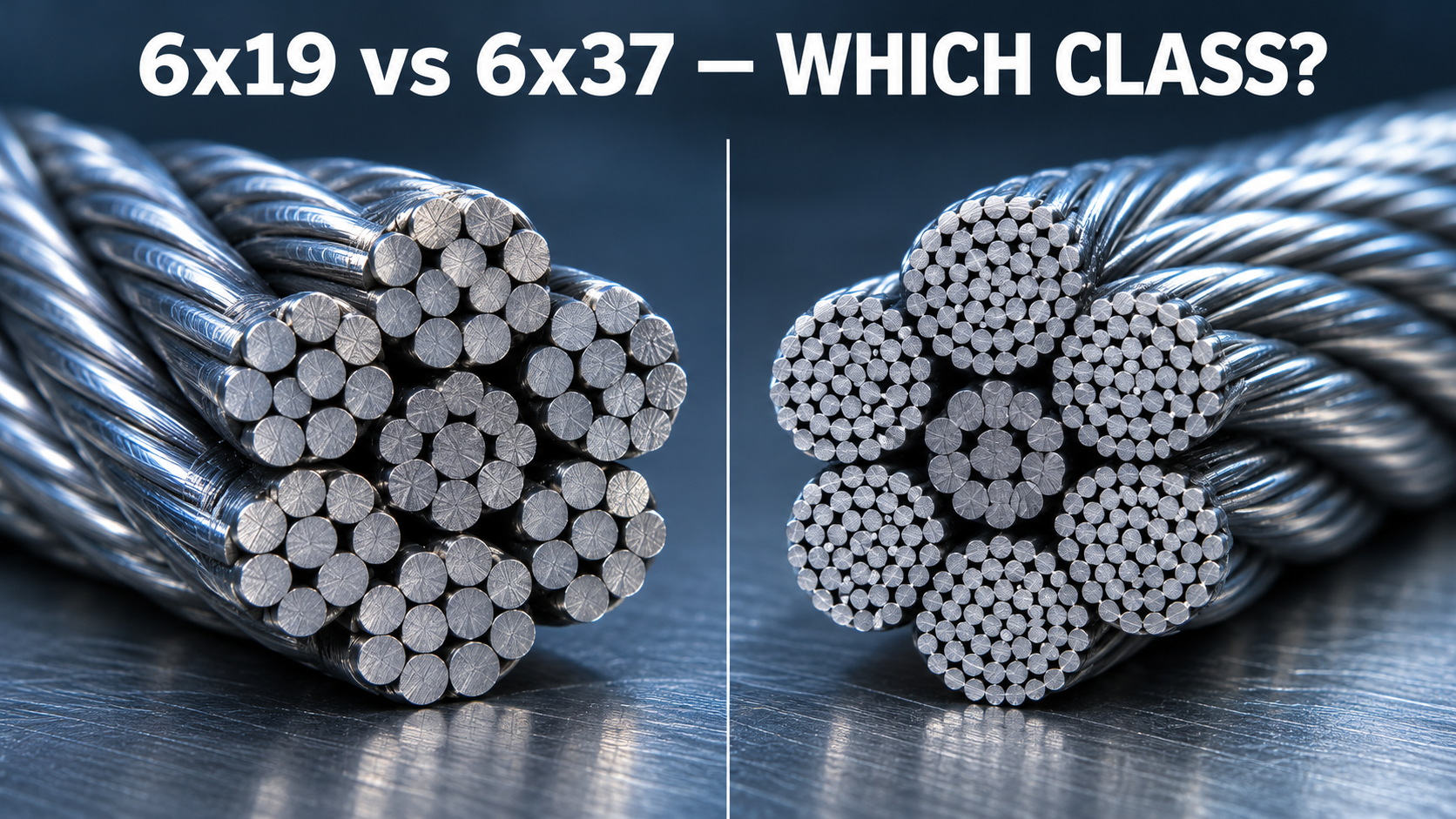
6x19 class wire rope (actual constructions: 6x19S, 6x25F, 6x26WS) uses fewer, thicker outer wires — better abrasion resistance, less flexibility. 6x37 class (6x36WS, 6x41WS, 6x49SWS) uses more, finer wires — better flexibility and fatigue life, slightly less wear resistance. Rule of thumb: 6x19 for straight-line hoisting and standing applications; 6x37 for ropes running over sheaves and drums, especially above 20mm diameter.
"6x19" and "6x37" are the two most common general-purpose wire rope specifications on crane, winch, and rigging RFQs, and they are also the two most misunderstood. Many buyers assume the numbers are an exact wire count, or that the rope with more wires must be stronger. Neither is true. This guide explains what a wire rope class is, which real constructions sit inside the 6x19 and 6x37 classes, how they trade flexibility against abrasion resistance, and how to choose — and specify — the right one for your equipment.
Wire Rope "Classes" Explained
In the name of a stranded rope, the first number is the number of strands and the second is the number of wires per strand. Our 7x7 vs 7x19 comparison covers how that notation works for small cables. For six-strand ropes, though, "6x19" and "6x37" are usually not exact constructions at all — they are classes: groups of constructions with a similar number of wires per strand, similar weight, and the same minimum breaking force.
EN 12385-4 and the US standards (API 9A, ASTM A1023) define the classes by the wire count of each strand. In EN 12385-4 the larger class is called the 6x36 class; in US practice it is the 6x37 class. They are the same group of ropes.
- 6x19 class: about 15 to 26 wires per strand, with 7 to 12 wires in the outer layer.
- 6x37 (6x36) class: about 27 to 49 wires per strand, with 12 to 18 wires in the outer layer.
So a rope sold as "6x19" may really have 19, 21, 25, or 26 wires per strand, and a "6x37" rope almost never has exactly 37. The table below lists the constructions you will meet in each class. Strand patterns are written from the center wire outward.
| Class | Construction | Strand pattern | Wires per strand | Outer wires per strand |
|---|---|---|---|---|
| 6x19 class | 6x19S (Seale) | 1-9-9 | 19 | 9 |
| 6x19 class | 6x19W (Warrington) | 1-6-(6+6) | 19 | 12 (alternating large and small) |
| 6x19 class | 6x21F (Filler) | 1-5-5F-10 | 21 | 10 |
| 6x19 class | 6x25F (Filler) | 1-6-6F-12 | 25 | 12 |
| 6x19 class | 6x26WS (Warrington-Seale) | 1-5-(5+5)-10 | 26 | 10 |
| 6x37 class | 6x31WS (Warrington-Seale) | 1-6-(6+6)-12 | 31 | 12 |
| 6x37 class | 6x36WS (Warrington-Seale) | 1-7-(7+7)-14 | 36 | 14 |
| 6x37 class | 6x41WS (Warrington-Seale) | 1-8-(8+8)-16 | 41 | 16 |
| 6x37 class | 6x49SWS (Seale-Warrington-Seale) | 1-8-8-(8+8)-16 | 49 | 16 |
| 6x37 class | 6x37M (classic cross lay) | 1-6-12-18 | 37 | 18 |
The only rope that literally has 37 wires per strand, 6x37M, is a multi-operation cross-lay construction in which the wire layers cross each other and notch at the contact points. It has largely been replaced by the equal-lay Warrington-Seale constructions above and is rarely produced for new equipment today. When an RFQ says "6x37", most mills will quote 6x36WS unless another construction is stated.
A rope class says nothing about the core. Each construction is available with a fiber core (FC) or an independent wire rope core (IWRC), and that choice changes strength, crush resistance, and stretch — see our guide to wire rope core types (FC vs IWRC vs WSC).
6x19 Class in Detail
All 6x19 class ropes have relatively large outer wires, which is what gives the class its wear resistance. The differences between them come from how the inner layers are built:
6x19S — Seale
A Seale strand has two layers with the same number of wires: nine large outer wires sit in the valleys of nine smaller inner wires. With only nine outer wires per strand, 6x19S has the thickest outer wires of any common six-strand rope, and therefore the best abrasion resistance and crush resistance in the class. The trade-off is the lowest flexibility and bending fatigue life. It suits ropes that drag over the ground or rub against guides, haulage ropes, and hoists with generous sheaves.
6x25F — Filler
A Filler strand places six very small filler wires in the gaps between the inner layer of six and the outer layer of twelve. The filler wires support the outer layer and keep the strand round, giving a dense, stable strand with good crush resistance. Twelve outer wires make 6x25F noticeably more flexible than 6x19S, with a bit less wear resistance. Because the filler wires carry little load, the same rope is sometimes written as 6x19F, counting only 1 + 6 + 12 = 19 main wires — another reason "6x19" is a family name rather than a wire count.
6x26WS — Warrington-Seale
The Warrington-Seale strand combines a Warrington inner layer (alternating large and small wires) with a Seale outer layer of ten wires. It has more steel in its cross-section than a Filler strand and outer wires that are thicker than 6x25F's, so it balances flexibility and abrasion resistance well. 6x26WS is the most widely used all-round construction in the 6x19 class, especially for slings and general hoisting in the 12–24mm range.
6x19W (Warrington) and 6x21F (Filler) are also produced, mostly in smaller sizes. All of them are interchangeable on paper, since they meet the same breaking force table, but they do not behave identically on a sheave. If your equipment manufacturer specifies a particular construction, quote it in full rather than writing "6x19".
6x37 Class in Detail
The 6x37 class uses three or four wire layers per strand and 12 to 18 outer wires, so each outer wire is roughly 30% thinner than in a 6x19 class rope of the same diameter. Thinner wires bend with less stress, which is the whole point of the class.
- 6x36WS (14 outer wires) is the workhorse of the class and the default construction for crane hoist ropes, winch ropes, and larger slings. It offers a good compromise between fatigue life and wear.
- 6x31WS (12 outer wires) sits at the boundary between the two classes, with slightly better abrasion resistance than 6x36WS; it is common in mid-size diameters.
- 6x41WS and 6x49SWS (16 outer wires) are used in large diameters, typically 32mm and above, where they keep the outer wire size in a range that tolerates repeated bending.
Why Large Diameters Default to the 6x37 Class
Outer wire size grows in proportion to rope diameter. In a 16mm 6x19S rope the outer wires are already about 1.0mm thick; in a 32mm 6x19S rope they are about 2mm. Bending stress in a wire rises with wire diameter for a given sheave, and sheave and drum sizes on real equipment do not grow freely with the rope. A large 6x19 class rope therefore fatigues quickly on any machine where it bends repeatedly, and it is very stiff to handle, reeve, and spool.
Moving to the 6x37 class brings the outer wires of a 32mm rope back down to roughly 1.4–1.5mm — still thicker than the outer wires of a mid-size 6x19 rope, so abrasion resistance remains reasonable. That is why the 6x19 class, although made up to 40mm and more, is used mostly in smaller sizes, and why 6x37 class is the normal choice for running ropes above about 20mm.
Flexibility vs Abrasion: The Core Trade-off
Almost every performance difference between the two classes comes from one variable: the size of the outer wires. Thick outer wires have more steel to lose before wear becomes significant and spread contact pressure better; thin outer wires bend with less stress and survive more cycles over sheaves. You cannot have both in the same rope.
| Property | 6x19 class | 6x37 class |
|---|---|---|
| Outer wires per strand | 9–12 | 12–18 (typically 14–16) |
| Outer wire size, 16mm rope (approx.) | 1.0 mm (6x19S) | 0.7 mm (6x36WS) |
| Bending fatigue life | Good | Better — more cycles over the same sheave |
| Abrasion resistance | Better | Good |
| Crushing resistance (drums, multi-layer spooling) | Better | Good — use IWRC |
| Suggested sheave D/d (approx.) | 40–51 (6x25F to 6x19S) | 32–35 (6x41WS to 6x36WS) |
| Typical diameter range | Up to about 40mm; most used up to 20mm | About 8–60mm; the default above 20mm |
| Minimum breaking force | Same at equal diameter, core, and grade | Same at equal diameter, core, and grade |
D/d is the ratio of sheave or drum tread diameter to rope diameter. The figures are typical industry suggestions for good service life; the minimum D/d for your machine is set by its design standard (for example ISO 4301, FEM 1.001, or ASME B30) and the equipment manufacturer, and always takes precedence.
The trade-off also affects inspection. Wear on a 6x19 class rope shows up as flat spots on a small number of thick outer wires; a 6x37 class rope tends to show more, smaller broken wires, which are harder to see. Discard criteria such as ISO 4309 are based on the number of load-bearing outer wires, so the allowable count of visible broken wires differs between classes — do not carry one class's numbers over to the other. Our wire rope inspection checklist covers what to look for and how often.
Breaking Strength Comparison
A common assumption is that 6x37 must be stronger "because it has more wires". It is not. At the same diameter, core type, and tensile grade, both classes have the same minimum breaking force. Splitting the steel into more, finer wires does not add steel; the metallic cross-section, and therefore the strength, stays essentially the same.
EN 12385-4 assigns both classes the same breaking force factor: K = 0.330 with a fiber core and K = 0.356 with an IWRC. Using the formula MBF (kN) = d² × K × R ÷ 1000, explained in our wire rope breaking strength formula guide, the minimum values are:
| Diameter | 6x19 or 6x37 class, FC, 1770 MPa | 6x19 or 6x37 class, IWRC, 1770 MPa | 6x19 or 6x37 class, IWRC, 1960 MPa |
|---|---|---|---|
| 10 mm | 58.4 kN | 63.0 kN | 69.8 kN |
| 12 mm | 84.1 kN | 90.7 kN | 100.5 kN |
| 16 mm | 149.5 kN | 161.3 kN | 178.6 kN |
| 20 mm | 233.6 kN | 252.0 kN | 279.1 kN |
| 24 mm | 336.4 kN | 362.9 kN | 401.9 kN |
| 32 mm | 598.1 kN | 645.2 kN | 714.5 kN |
Calculated minimum breaking force per EN 12385-4 factors. Multiply kN by 224.8 for pounds-force. Individual manufacturers may publish slightly higher catalog values for particular constructions, such as 6x36WS, but the standard minimum is the same for both classes.
What actually changes breaking force is the core (IWRC adds about 8% over FC) and the tensile grade (1960 MPa adds about 11% over 1770 MPa) — not the class. If you need more strength without increasing diameter, change the grade or the core, or consider a compacted construction. For stainless and small-diameter constructions, see the full wire rope breaking strength chart, and to turn breaking force into a safe load, our working load limit guide.
Which Class for Your Application
The deciding question is whether the rope bends repeatedly in service or mainly wears against things. Use the table as a starting point, and follow the equipment manufacturer's specification where one exists.
| Application | Recommended class | Typical construction | Reason |
|---|---|---|---|
| Crane hoist rope (overhead and mobile cranes) | 6x37 class | 6x36WS+IWRC, 1960 MPa | Constant cycling over sheaves and drums; IWRC for crush resistance on the drum. Tall single-fall lifts need a rotation-resistant rope instead. |
| Winch rope (drum winches, capstans) | 6x37 class; 6x19 class where the rope drags | 6x36WS+IWRC; 6x19S+IWRC for ground-dragging lines | Drum spooling favors flexibility; tow and recovery lines that scrape over ground or rock favor thick outer wires. |
| Traction elevator | Neither — 8-strand rope | 8x19S+FC or 8x19W+FC (EN 12385-5) | Elevator ropes are a separate family: eight strands and a fiber core give the flexibility and traction grip needed on small traction sheaves. |
| Mooring lines and mooring winches | 6x37 class | 6x36WS+IWRC galvanized | Large diameters, repeated spooling and fairlead bending; heavy galvanizing for seawater. |
| Wire rope slings | 6x19 class up to about 20mm; 6x37 class above | 6x26WS / 6x19S+IWRC; 6x36WS+IWRC | Small slings meet abrasive load edges; large slings and choker hitches need flexibility to handle and bend around loads. |
| Trashrack cleaning machines and hydropower screen hoists | 6x37 class | 6x36WS+IWRC galvanized, or 316 stainless | The rake or gate hoist rope runs over drums and sheaves every cycle, partly submerged in silt-laden water; fatigue governs life. Where the rope rubs on the rack or guides, a 6x26WS can trade some fatigue life for wear resistance. |
| Standing rigging, guys, and stays | 6x19 class | 6x19S+IWRC or 6x26WS+IWRC galvanized | No repeated bending; thicker outer wires resist corrosion loss and abrasion. Small diameters use 1x19 or 7x7 instead. |
| Haulage, scrapers, and draglines | 6x19 class | 6x19S+IWRC | Heavy abrasion from the ground dominates; bending is secondary. |
Hydropower trashrack cleaners are an application we have supplied, and they show the trade-off clearly. The hoist rope works intermittently in cold, sediment-laden water, wraps on a drum, and passes over sheaves on every cleaning cycle. A rope chosen only for wear resistance will usually retire early from fatigue breaks near the sheaves, so the 6x37 class with an IWRC is the usual starting point, in galvanized carbon steel or 316 stainless depending on water chemistry and how long the rope stays submerged.
Stainless Steel Options
Both classes are made in stainless steel. We supply 6x19+IWRC from 5 to 40mm and 6x37+IWRC from 8 to 52mm in AISI 304 and 316, the same constructions used in carbon steel rope. A few points differ from carbon steel:
- Grade: stainless rope is drawn to 1570 or 1770 MPa, not 1960 MPa, so a stainless rope is weaker than a 1960 MPa galvanized rope of the same size. Check the breaking force before substituting one for the other. Our tensile grades guide explains the grade system.
- Core: use an IWRC. A fiber core holds moisture against the stainless wires and defeats the purpose of the material. See core types for details.
- Alloy: 316 for seawater, brackish water, and splash zones; 304 for freshwater and dry indoor or outdoor use. The 304 vs 316 comparison covers the choice.
- Fatigue: stainless wire generally has lower bending fatigue life than carbon steel wire, which makes the flexibility of the 6x37 class even more valuable for stainless ropes running over sheaves.
How to Read a Full Rope Designation
Here is a typical line from a crane or winch RFQ, broken down part by part:
"16mm 6x36WS+IWRC 1960 MPa galvanized"
| Part | Meaning |
|---|---|
| 16mm | Nominal rope diameter, measured across the strand crowns — see how to measure wire rope diameter |
| 6 | Six outer strands |
| 36 | 36 wires per strand, which places the rope in the 6x37 (6x36) class |
| WS | Warrington-Seale strand pattern, 1-7-(7+7)-14, with 14 outer wires per strand |
| +IWRC | Independent wire rope core — a small 7x7 steel rope in the center |
| 1960 MPa | Tensile grade of the wires (≈ G200, ≈ US EIPS); the minimum breaking force is 16² × 0.356 × 1960 ÷ 1000 = 178.6 kN (about 40,150 lbs) |
| galvanized | Zinc-coated carbon steel wire; state the coating class (for example class B or A per EN 10264-2) if it matters |
This line is a good start, but it leaves several things for the supplier to assume. A complete specification would add:
- Lay: right regular lay (sZ) unless your drum or equipment needs left or lang lay
- Minimum breaking force: ≥ 178.6 kN, so a different construction cannot be substituted with a lower value
- Standard: EN 12385-4, GB/T 20118, or API 9A
- Lubrication: lubricated throughout, especially for drum and outdoor service
- Length and packaging: for example 2 × 250m on steel or wooden reels
- Documents: mill certificate with wire tensile results and a rope break test
Written in full: "16mm 6x36WS+IWRC, 1960 MPa, galvanized class B, sZ, MBF ≥ 178.6 kN, EN 12385-4, lubricated, 2 × 250m on reels, with 3.1 certificate." If the RFQ only says "6x37", the supplier may quote any construction in the class. That is acceptable for many uses, but if your sheaves were designed for a particular rope, name the construction.
Frequently Asked Questions
What is the difference between 6x19 and 6x37 wire rope?
Both are six-strand rope classes with the same minimum breaking force at a given diameter, core, and grade. The 6x19 class (6x19S, 6x25F, 6x26WS) has 15–26 wires per strand with fewer, thicker outer wires, so it resists abrasion and crushing better but is stiffer. The 6x37 class (6x36WS, 6x41WS, 6x49SWS) has 27–49 wires per strand with more, finer outer wires, so it is more flexible and lasts longer over sheaves and drums, with somewhat less wear resistance.
Is 6x36 the same as 6x37?
In practice, yes. 6x36WS is the most common construction in the 6x37 class, and EN 12385-4 calls the whole class "6x36" while US standards call it "6x37". A true 6x37 rope (1-6-12-18 cross lay) is rarely made today, so a 6x36WS rope is the normal answer to a 6x37 request and meets the same breaking force table.
Which wire rope class is more flexible?
The 6x37 class. Its outer wires are about 30% thinner than those of a 6x19 class rope of the same diameter, so it bends with less stress, works on smaller sheaves, and survives more bending cycles. Within the 6x19 class, 6x25F is the most flexible and 6x19S the stiffest.
Is 6x37 wire rope stronger than 6x19?
No. At the same diameter, core, and tensile grade, the two classes have the same minimum breaking force — EN 12385-4 uses the same factor for both (K = 0.356 with IWRC). A 16mm rope with IWRC in 1770 MPa grade has a minimum breaking force of about 161.3 kN in either class. Strength is changed by the grade and the core, not by the number of wires.
Can I replace 6x19 wire rope with 6x37?
Often, yes: the breaking force is the same and the 6x37 class will usually last longer on sheaves and drums. Check three things first: whether the rope drags or rubs, where 6x37 will wear faster; whether it spools in many layers on a drum, where crush resistance matters and an IWRC is essential; and whether the equipment manufacturer specifies a construction. For cranes and hoists, follow the manufacturer's rope specification.
Get a Quote for 6x19 or 6x37 Class Rope
Send us your diameter, construction or class, core, grade, finish, and length — or just describe the machine and how the rope runs. Our engineers will recommend the right class, confirm the breaking force against your requirement, and typically respond within 2 hours during business hours. See our product range and specifications for sizes in stock.