Quick Answer
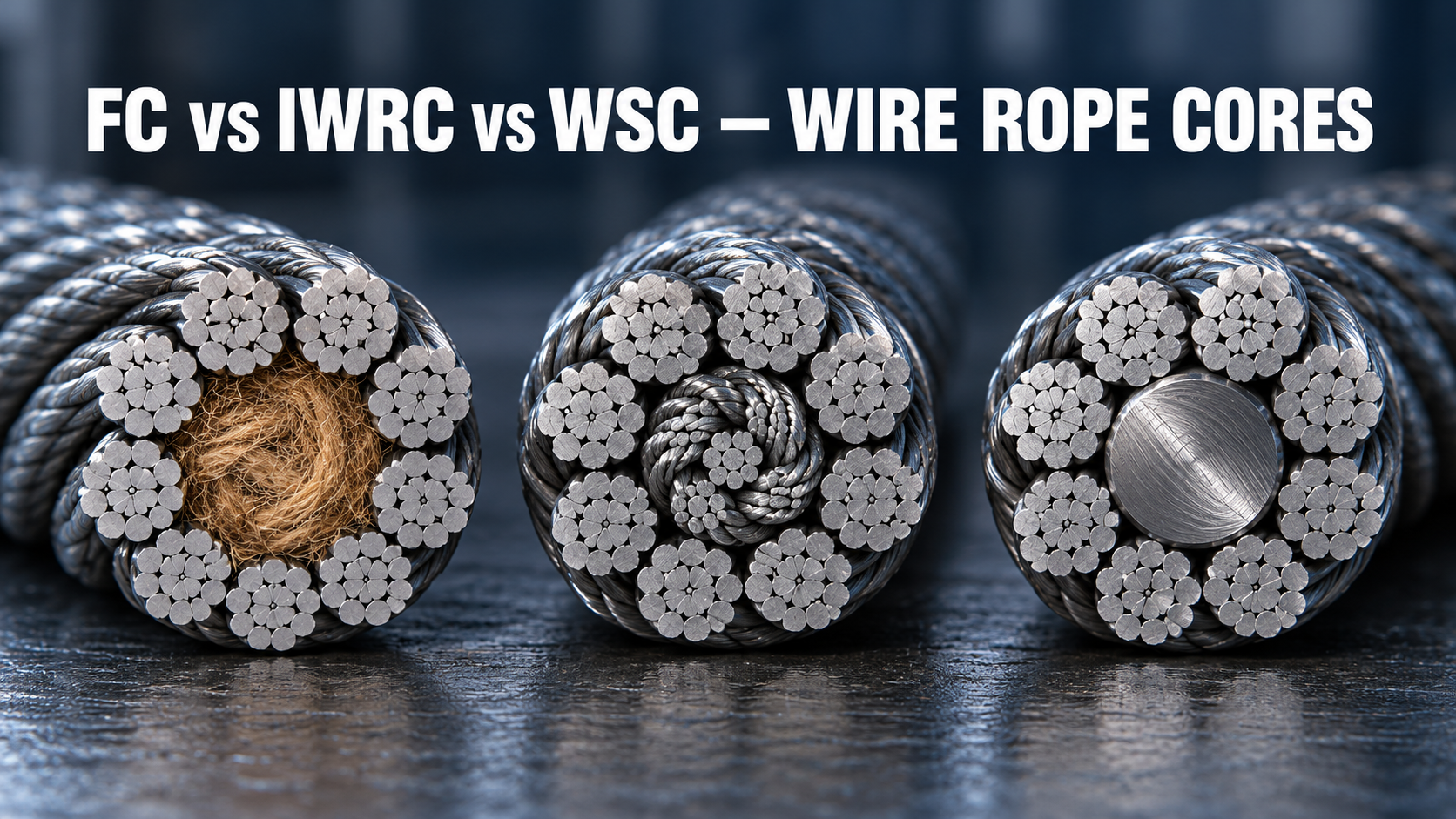
Wire rope cores come in three main types: FC (Fiber Core — natural or synthetic fiber), IWRC (Independent Wire Rope Core — a separate small wire rope at the center), and WSC (Wire Strand Core — a single steel strand). IWRC adds roughly 7.5% strength and better crush resistance; FC offers more flexibility and holds lubricant. For cranes and hoisting, specify IWRC; for light duty and better bendability, FC is acceptable.
Open almost any industrial RFQ for wire rope and you will find a line that reads "CORE: IWRC" or "6x19+FC". The core is the part of the rope you never see once it is installed, yet it decides how much load the rope carries, whether it survives being wound in layers on a drum, how much it stretches, and how hot it can run. Ordering the wrong core is one of the quietest ways to get a rope that matches the drawing on diameter and construction but fails early in service. This guide explains the three wire rope core types, what IWRC means on a specification, how core choice changes strength and stretch, and which core to specify for each application.
What the Core Does in a Wire Rope
A stranded wire rope is built in layers: wires are twisted into strands, and strands are laid helically around a central core. The core is the foundation the outer strands are closed onto, and it has three jobs:
- Support the outer strands. Under load, every outer strand presses inward. The core keeps the strands spaced correctly so they bear on the core rather than grinding against each other at the contact points between neighbors.
- Keep the rope round. When a rope runs over a sheave or is spooled onto a drum, the sheave groove and the rope layers above push it sideways. A firm core resists that pressure and stops the rope from flattening into an oval, which would distort the strands and concentrate wear.
- Carry part of the load. A steel core is part of the rope's metallic cross-section and shares the tension with the outer strands. A fiber core contributes essentially nothing to strength — its contribution is support and lubrication.
There are only three ways to fill the center of a stranded rope, and they are what the abbreviations FC, IWRC, and WSC describe:
FC — Fiber Core
A fiber core is a small fiber rope at the center of the wire rope. It is the oldest core type and is still standard on general-purpose six-strand ropes such as 6x19+FC and 6x37+FC. Two materials are used, and specifications sometimes distinguish them:
- Natural fiber core (NFC) — usually sisal, sometimes manila or hemp. Natural fibers soak up rope lubricant during manufacture and slowly release it to the wires in service. The downside is that they absorb water too and can rot, especially in ropes that are stored wet or run in humid conditions.
- Synthetic fiber core (SFC) — usually polypropylene. It does not rot, has a more consistent diameter, and gives a more uniform rope. It holds less lubricant than sisal and has a lower heat tolerance, since polypropylene softens well below the temperature at which steel is affected.
Advantages of fiber core: the rope is more flexible and bends more easily over small sheaves; the core acts as a built-in lubricant reservoir that protects the inner wires; the rope is lighter (roughly 10% lighter than the same size with an IWRC); and it is usually the lowest-cost option.
Limitations: lower breaking force, because the core carries no load; poor resistance to crushing, so FC ropes flatten on multi-layer drums and under high sheave pressure; more stretch, as the fiber compresses and the strands bed in; a temperature ceiling of roughly 80–100 °C before the fiber is damaged; and a core that can dry out, shrink, or rot internally, which shows up as a loss of diameter.
Typical applications: general hoisting on single-layer drums, light lifting, hand-spliced slings and lashings where flexibility matters, and haulage ropes that drag along the ground (6x7+FC), where the core keeps the rope soft and the large outer wires take the abrasion.
IWRC — Independent Wire Rope Core
IWRC stands for Independent Wire Rope Core. Instead of a fiber rope, the center of the rope is a complete, separately manufactured small wire rope — most often a 7x7 construction — and the outer strands are closed around it. "Independent" means the core is made as its own rope before the outer strands are laid on; it is not just an extra strand. That is why the specification for a rope such as 6x19+IWRC is effectively "six strands of 19 wires, around a 7x7 wire rope".
What the steel core gives you:
- Higher breaking force — about 7.5% more. The core adds metallic area that shares the load. US catalog practice treats an IWRC rope as 7.5% stronger than the same rope with a fiber core; the EN 12385-4 breaking force factors (0.356 for IWRC vs 0.330 for FC in the 6x19 and 6x36 classes) give about 8%. Either way, it is enough to move a rope into the next strength bracket without changing diameter — see the wire rope breaking strength formula for how the factors work.
- Crush resistance. A steel core does not compress the way fiber does, so the rope keeps its round shape when it is spooled under tension in several layers on a drum, when the upper layers bear down on the lower ones, and when it runs over sheaves under high load.
- Heat resistance. With no fiber to char or melt, an IWRC rope is suitable for high-temperature work such as foundries, steel mills, and furnace charging, within the limits of the lubricant and the wire grade.
- Less stretch and a stable diameter over the life of the rope, because there is no fiber to compact.
The trade-offs are a little less flexibility, about 10% more weight, a slightly higher price, and the need for regular external lubrication, since a steel core has no reservoir of its own.
Why lifting specifications insist on IWRC. Cranes and hoists combine every condition that a fiber core handles badly: high loads, multi-layer spooling under tension, small drum and sheave ratios, and often heat or shock loading. A crushed core lets the outer strands sink in and distort, which breaks wires internally where an inspector cannot see them. Most mobile and tower crane manufacturers specify steel-core ropes as standard, and most purchasing specifications for hoisting duty simply write "CORE: IWRC". If an RFQ specifies IWRC, a fiber core rope of the same size is not an acceptable substitute — it is weaker and will not pass the breaking force requirement.
WSC — Wire Strand Core
A wire strand core is a single steel strand at the center of the rope, usually the same construction as the outer strands. It is the standard core for small diameter ropes, where making a separate miniature wire rope for the core would be impractical. You may also see it written as IWS (independent wire strand).
The most common small ropes are WSC ropes, even though their names don't say so:
- 7x7 = 6x7+WSC — six strands of 7 wires around a seventh 7-wire strand.
- 7x19 = 6x19+WSC — six strands of 19 wires around a seventh 19-wire strand.
The "7" in 7x7 and 7x19 counts the core strand. When a buyer asks us for "7x19 with a steel core", the rope is already a steel core rope; when a drawing calls for "6x19+WSC" in a small diameter, a standard 7x19 is the matching product. Our stainless steel 7x7 (0.5–10mm) and 7x19 (1.5–16mm) ropes on the specifications page are both WSC constructions. For the practical difference between the two — 7x7 is stiffer and more abrasion resistant, 7x19 is more flexible — see our 7x7 vs 7x19 wire rope construction comparison.
A WSC rope is strong for its size, very resistant to crushing, and has low stretch. It is less flexible than an IWRC rope of comparable construction, which is acceptable at small diameters where bending stresses are low.
Core Type Notation Decoded
Rope constructions are written as outer strands × wires per strand + core. A letter after the wire count describes how the wires in each strand are arranged (S = Seale, W = Warrington, Fi = Filler, WS = Warrington-Seale). Here is how to read the notations you will meet in catalogs and RFQs:
| Notation | How to read it | Core |
|---|---|---|
| 6x19+FC | 6 strands of 19 wires around a fiber core | Fiber (natural or synthetic) |
| 6x19+NFC / 6x19+SFC | Same, with the fiber type stated: natural (sisal) or synthetic (polypropylene) | Fiber |
| 6x19+IWRC | 6 strands of 19 wires around an independent wire rope core (usually 7x7) | Steel — small wire rope |
| 6x19S+IWRC | 6 Seale strands (1+9+9 wires) around an IWRC; large outer wires for abrasion resistance | Steel — small wire rope |
| 6x36WS+IWRC | 6 Warrington-Seale strands of 36 wires around an IWRC; more flexible than 6x19 | Steel — small wire rope |
| 6x19+WSC / 6x19+IWS | 6 strands of 19 wires around a single 19-wire strand | Steel — single strand |
| 7x19 | Shorthand for 6x19+WSC: 7 strands of 19 wires, one of which is the core | Steel — single strand |
| 7x7 | Shorthand for 6x7+WSC: 7 strands of 7 wires, one of which is the core | Steel — single strand |
| 1x19 | A single strand of 19 wires (1+6+12); not a stranded rope, so no core | None (center wire only) |
Two points cause most mix-ups. First, "6x19" is often used as the name of a class covering strands of about 15 to 26 wires, so a 6x19 rope may in practice be a 6x19S, 6x19W, 6x25Fi, or 6x26WS — if a particular arrangement matters, state it. Second, the US abbreviations IPS and EIPS (Improved Plow Steel, Extra Improved Plow Steel) describe the wire strength grade, not the core: "6x19 EIPS IWRC" is a 6x19 rope in EIPS grade with an IWRC. In metric specifications the grade is written as a tensile strength instead, such as 1770 or 1960 N/mm².
A complete core specification in an RFQ therefore reads something like: "16mm 6x19S+IWRC, 1770 N/mm², bright, right regular lay, EN 12385-4."
Strength Comparison: Same Rope, Different Core
To isolate the effect of the core, take a single rope — 16mm 6x19 — and change only the core. Minimum breaking force is calculated as d² × R × K ÷ 1000, using the EN 12385-4 factors for the 6x19 class (K = 0.330 for FC, 0.356 for IWRC):
| Wire grade | 16mm 6x19+FC | 16mm 6x19+IWRC | Gain from IWRC |
|---|---|---|---|
| 1570 N/mm² | 132.6 kN (29,820 lbs / 13.5 t) | 143.1 kN (32,170 lbs / 14.6 t) | +10.5 kN (+7.9%) |
| 1770 N/mm² | 149.5 kN (33,610 lbs / 15.2 t) | 161.3 kN (36,260 lbs / 16.4 t) | +11.8 kN (+7.9%) |
| 1960 N/mm² | — | 178.6 kN (40,160 lbs / 18.2 t) | IWRC only in our range |
Weight moves in the same direction: the IWRC rope is roughly 102 kg per 100 m against about 92 kg for the FC rope, so the extra strength costs some extra weight on the hook. Two conclusions follow. Changing from FC to IWRC is worth about the same as moving up one wire grade. And because the gain is under 10%, an IWRC does not compensate for an undersized rope; diameter is still the dominant factor, since breaking force scales with its square. For full tables by diameter, see the wire rope breaking strength chart.
These are calculated minimum values. Actual breaking force is verified by a destructive test on a sample from the production length; our guide to wire rope testing methods and standards explains how the test is run under ISO 3108 and what the mill certificate should show.
How Core Choice Affects Stretch & Crush Resistance
Every stranded rope stretches in two ways: constructional stretch, a permanent elongation in the first period of service as the strands bed down onto the core, and elastic stretch, which recovers when the load is removed. The core has a large effect on the first and a smaller effect on the second.
| Property | FC | IWRC | WSC |
|---|---|---|---|
| Constructional stretch (typical, normal loading) | 0.5–0.75% | 0.25–0.5% | Low, similar to IWRC |
| Elastic stretch | Highest (lower modulus) | Lower | Lower |
| Crush resistance on drums and sheaves | Poor | Good | Good |
| Diameter loss in service | Faster (core compaction, drying) | Slow | Slow |
| Flexibility | Best | Good | Lower |
In practice: a 20 m hoist line in a fiber core rope can grow by 100–150 mm in its first weeks of service, against 50–100 mm for an IWRC. That matters for hoist limit switches, for fixed-length pendants and guys, and anywhere the rope length has to stay set.
Crush resistance matters most on multi-layer drums. Where the rope crosses over itself at the layer change, and where the upper wraps squeeze the lower ones, a fiber core rope flattens, the strands lose their support, and wires start to break internally at the contact points with the core. The same failure starts when a rope runs in a sheave groove that is too small or too large. An IWRC or WSC holds the shape. When inspecting an FC rope, a local reduction in diameter is often the first sign of a failed core.
Stainless Steel Rope Cores
Stainless steel wire rope follows different conventions from galvanized and bright rope, and almost all of it has a steel core:
- Small diameters use WSC. Stainless 7x7 and 7x19 — the bulk of what is used for marine rigging, control cables, balustrades, and gym equipment — are 6x7+WSC and 6x19+WSC ropes.
- Larger diameters use IWRC. Stainless 6x19+IWRC and 6x37+IWRC are used for marine and port hoisting, offshore equipment, and lifting in corrosive or food-grade environments. We supply 6x19+IWRC from 5 to 40mm and 6x37+IWRC from 8 to 52mm in 304 and 316 — see the full range on our products page.
- Fiber cores are avoided. A fiber core holds water and salt against the inside of the strands. Stainless steel stays corrosion resistant only while oxygen can reach its surface, and a permanently wet core starves the inner wires of oxygen, which leads to crevice corrosion where it cannot be seen. If you are paying for stainless to resist corrosion, a steel core keeps that resistance through the whole rope.
For grade and construction choices beyond the core, see our guide to choosing stainless steel wire rope and the 304 vs 316 comparison.
Which Core for Your Application
Use this table as a starting point. Where an equipment manufacturer or a standard specifies the rope, follow that specification:
| Application | Recommended core | Typical construction | Why |
|---|---|---|---|
| Cranes, hoists, winches (multi-layer drums) | IWRC | 6x19S+IWRC, 6x36WS+IWRC | Crush resistance, highest strength, low stretch |
| Single-fall lifts that must not spin | Steel (rotation-resistant) | 19x7 | Counter-laid strands balance torque |
| High-temperature work (foundries, mills) | IWRC | 6x19+IWRC, 6x37+IWRC | No fiber to char or melt |
| Wire rope slings | IWRC (FC for light, flexible slings) | 6x19+IWRC, 6x37+IWRC | Strength and resistance to crushing at the eye and under load |
| Running rigging, pulleys, small sheaves | FC (larger sizes) or WSC (small sizes) | 6x19+FC, 7x19 | Flexibility over sheaves |
| Aircraft and control cable | WSC | 7x7, 7x19 | Small diameter, flexible, low stretch |
| Gym equipment cables | WSC | 7x19 (coated) | Flexibility over pulleys, fatigue life |
| Standing rigging, cable railing, guy wires | None — single strand | 1x19 | Highest strength and stiffness, lowest stretch |
| Haulage and dragging along the ground | FC | 6x7+FC | Large outer wires for abrasion, soft core |
A note on 1x19. For standing rigging, the question of core type does not really arise: 1x19 is a single strand of 19 wires — one center wire, a layer of 6, and a layer of 12 — rather than strands laid around a core. Having nothing to compress makes it the strongest and lowest-stretch option at a given diameter, but it is too stiff for sheaves.
A note on aircraft cable. "Aircraft cable" refers to 7x7 and 7x19 WSC ropes made to MIL-DTL-83420 or similar specifications. For how it differs from general wire rope, see aircraft cable vs wire rope.
Whatever core you choose, the working load is the minimum breaking force divided by the design factor for the application — the working load limit guide covers the factors used for lifting and rigging.
Frequently Asked Questions
What does IWRC stand for?
IWRC stands for Independent Wire Rope Core. It means the core of the rope is a separate small wire rope — usually a 7x7 — rather than a fiber core or a single strand. On a specification it is written after the construction, as in 6x19+IWRC or 6x36WS+IWRC, and it indicates a rope with higher strength and better crush resistance than the fiber core version.
Is IWRC stronger than fiber core?
Yes. An IWRC rope is about 7.5–8% stronger than the same size and grade with a fiber core, because the steel core carries part of the load while a fiber core carries almost none. For example, a 16mm 6x19 rope in 1770 N/mm² grade has a minimum breaking force of about 149.5 kN with a fiber core and 161.3 kN with an IWRC. IWRC is also far more resistant to crushing.
Can fiber core wire rope be used for cranes?
Sometimes, but IWRC is the safer default. Fiber core rope is still used on some light-duty overhead cranes and hoists with single-layer drums, large sheaves, and normal temperatures, where its flexibility is an advantage. For multi-layer spooling, high loads, heat, or mobile and tower cranes, specify IWRC — a fiber core flattens under drum pressure and fails internally. Always use the rope type specified by the crane manufacturer.
What is the difference between IWRC and WSC?
Both are steel cores. An IWRC is a complete small wire rope, usually 7x7, at the center of a larger rope. A WSC (wire strand core) is a single strand, normally the same as the outer strands. WSC is used in small ropes such as 7x7 (6x7+WSC) and 7x19 (6x19+WSC); IWRC is used in larger ropes, where it gives better flexibility and fatigue performance than a single strand.
Does stainless steel wire rope have a fiber core?
Rarely. Stainless steel 7x7 and 7x19 ropes have a wire strand core, and larger stainless ropes such as 6x19 and 6x37 are normally made with an IWRC. Fiber cores are avoided because they hold moisture against the inner wires, which can cause hidden crevice corrosion in stainless steel.
Get the Core Right on Your Next Order
Send us the construction, core, diameter, grade, and quantity from your RFQ — or just the application and load — and our engineering team will confirm the right core, check the breaking force against your requirement, and typically respond within 2 hours during business hours.