Quick Answer
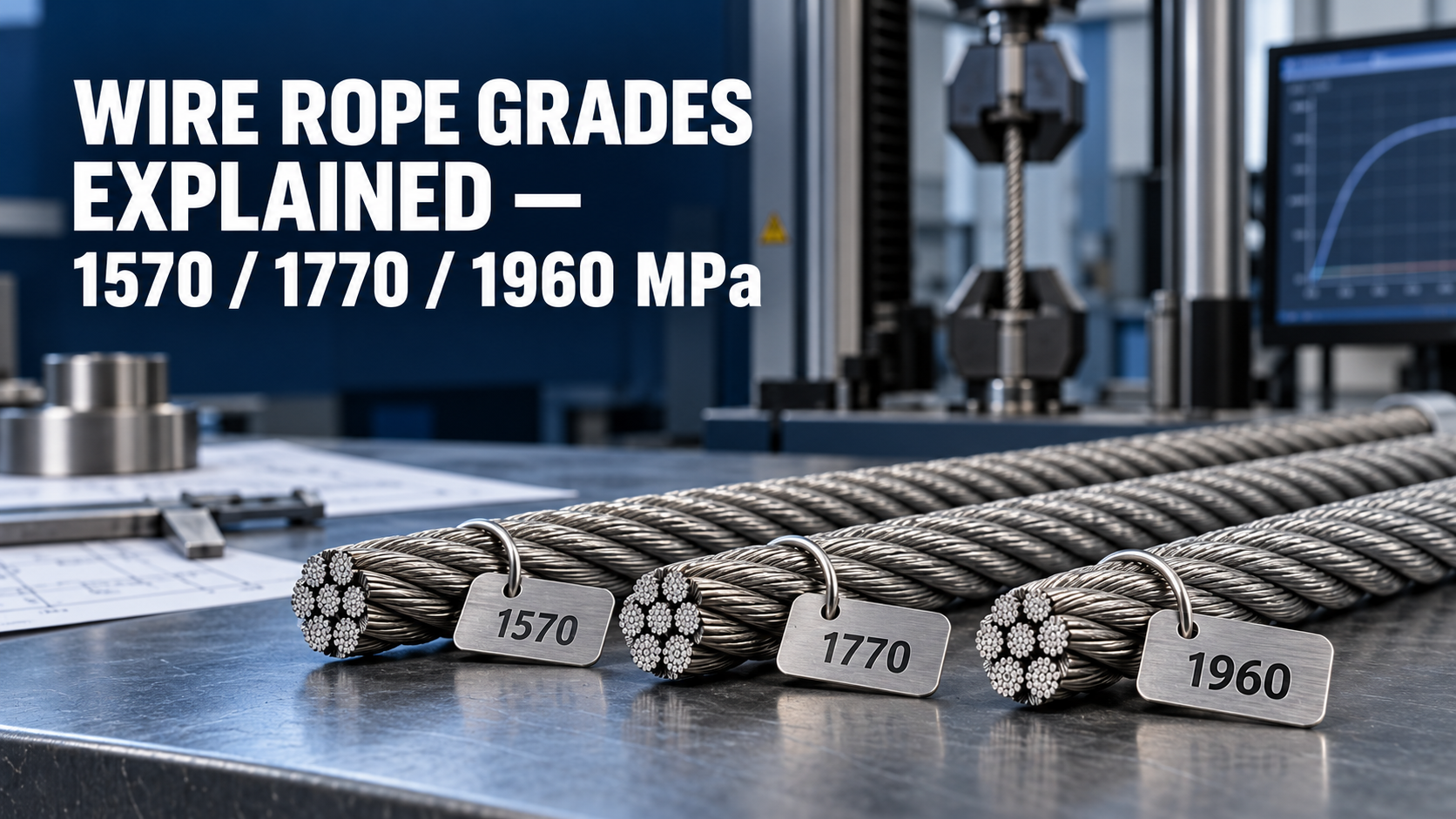
Wire rope tensile grade is the nominal strength of the individual wires, in MPa (N/mm²). Common grades: 1570, 1770, 1870, 1960, 2160 MPa. The same grades appear in older notation as kgf/mm² (G160 ≈ 1570, G180 ≈ 1770, G200 ≈ 1960) and in US notation as IPS (≈1770), EIPS/XIP (≈1960), and EEIPS/XXIP (≈2160). Higher grade = higher breaking strength for the same diameter and construction.
A buyer in Germany asks for "1770 N/mm²". A distributor in Indonesia asks for "G180". A crane contractor in Texas asks for "EIPS". All three may be describing nearly the same rope, but each is using a different system, and quotations get delayed or mismatched while everyone works out what the other side means. This guide explains what a wire rope tensile grade actually measures, how the metric MPa grades, the older kgf/mm² "G" grades, and the US IPS/EIPS grades line up, how grade changes breaking strength, and how to write the grade on an RFQ so that every supplier quotes the same thing.
What Tensile Grade Actually Measures
The tensile grade is a property of the wire, not of the finished rope. It is the nominal minimum tensile strength of the individual steel wires the rope is made from, expressed as force per unit area: megapascals (MPa), which is the same as newtons per square millimeter (N/mm²). A "1770 grade" rope is made from wires that each withstand at least about 1770 N for every square millimeter of their cross-section before they fracture.
That is different from the rope's minimum breaking force (MBF), which is a force in kN, lbs, or tonnes. Breaking force depends on three things: the wire grade, the rope diameter, and the construction (how much steel the cross-section holds and how much strength is lost to the helical lay). The relationship is:
MBF (kN) = d² × K × R ÷ 1000
where d is the rope diameter in mm, K is the breaking force factor for the construction, and R is the tensile grade in MPa. Grade is one input; it is not the answer. Two ropes in 1770 grade can have very different breaking forces if their diameters or constructions differ. For a full explanation of each term and K values by construction, see our wire rope breaking strength formula guide.
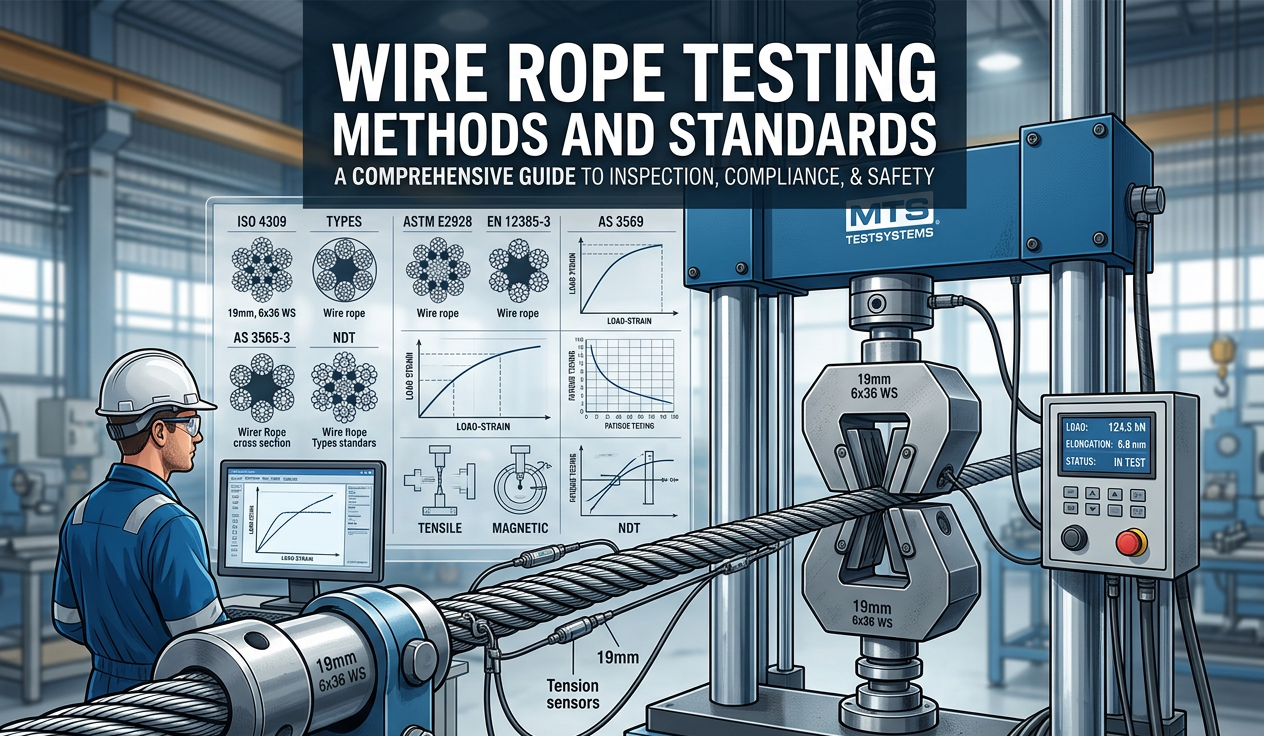
Two more points worth knowing. First, the grade is a nominal lower value: wires from a 1770 grade lot will test somewhat above 1770 MPa, within a tolerance band set by the wire standard. Second, the grade is verified on individual wires taken from the rope or the wire lot, by tensile, torsion, and bend tests, while the breaking force is verified by pulling a full rope sample to failure. A complete mill certificate reports both — our guide to wire rope testing methods and standards explains what each test shows.
The Metric System: 1570 / 1770 / 1870 / 1960 / 2160 MPa
Metric grades are used in ISO 2408, EN 12385, and the Chinese GB/T standards, and they are the most widely used system in international trade. The number is simply the nominal wire strength in MPa. These are the grades you will meet most often:
| Grade (MPa) | Position | Typical use |
|---|---|---|
| 1570 | Lower grade, more ductile wire | Stainless steel ropes (alternative grade in GB/T 9944), flexible cords, ropes formed around tight radii, general purpose ropes where strength is not critical |
| 1770 | The default grade worldwide | General purpose galvanized and bright ropes, slings, stainless steel wire rope, rigging; the grade assumed when a datasheet does not state one |
| 1870 | Intermediate grade, common in Chinese standards | Hoisting and crane ropes where 1770 falls slightly short; listed in GB/T 20118 but less often quoted outside Asia |
| 1960 | High-tensile grade | Crane and hoist ropes, winch lines, offshore and mooring ropes, compacted and high-performance constructions; the closest match to US EIPS |
| 2160 | Extra high-tensile grade | Special crane ropes, mine hoist ropes, and applications where diameter or weight is strictly limited; requires careful attention to sheaves and drums |
You may also see 1670 MPa, a less common grade between 1570 and 1770 that appears in Chinese standards, and 1370 or 1470 MPa in older or elevator rope specifications. Elevator ropes are sometimes "dual tensile", with softer outer wires (for example 1370 MPa) and stronger inner wires (1770 MPa), written as 1370/1770.
Stainless steel wire rope is almost always 1570 or 1770 MPa. Grades of 1870 and above are normally carbon steel, supplied bright or galvanized.
Legacy Notation: G160, G180, G200 (kgf/mm²)
Before SI units were adopted, wire strength was expressed in kilograms-force per square millimeter (kgf/mm², often written kg/mm²). The grade was named after that number, so a rope made from 180 kgf/mm² wire became "G180" or "Grade 180". The notation is still used on many RFQs and stock lists in Southeast Asia, the Middle East, and parts of South Asia, and on older Japanese, Korean, and Chinese drawings. If a purchase order asks for G180, the buyer is specifying a wire strength, not a different product.
To convert, multiply by 9.807 (1 kgf = 9.80665 N):
MPa = kgf/mm² × 9.807 — for example, 180 × 9.807 = 1765 MPa, which rounds to the standard 1770 grade.
| Legacy grade | kgf/mm² | Exact conversion (MPa) | Equivalent metric grade |
|---|---|---|---|
| G160 | 160 | 1569 | 1570 MPa |
| G170 | 170 | 1667 | 1670 MPa |
| G180 | 180 | 1765 | 1770 MPa |
| G190 | 190 | 1863 | 1870 MPa |
| G200 | 200 | 1961 | 1960 MPa |
| G220 | 220 | 2158 | 2160 MPa |
The metric grades were chosen as rounded equivalents of the old kgf/mm² steps, which is why the pairs match so closely. The differences of a few MPa are smaller than the normal tolerance on wire strength, so in practice G180 and 1770 MPa are treated as the same grade, as are G160 and 1570, and G200 and 1960.
One common misreading: the "G" stands for grade. It does not mean galvanized. A G180 rope can be bright (ungalvanized) or galvanized, and the finish has to be stated separately.
US Notation: IPS, EIPS (XIP), EEIPS (XXIP)
In the United States, wire rope grades carry names inherited from the 19th-century steel industry rather than numbers. The names refer to plow steel, the high-carbon steel once used for plowshares, and each step up adds roughly 10% to the breaking strength:
| US grade | Full name | Approx. metric grade | Notes |
|---|---|---|---|
| IPS | Improved Plow Steel | ≈1770 MPa | The traditional standard grade; now largely replaced by EIPS for crane work |
| EIPS (XIP) | Extra Improved Plow Steel | ≈1960 MPa | About 10% stronger than IPS; the most common grade for US general purpose and crane ropes today |
| EEIPS (XXIP) | Extra Extra Improved Plow Steel | ≈2160 MPa | About 10% stronger than EIPS; used in high-performance crane and mining ropes |
XIP and XXIP are designations some US manufacturers use for their EIPS and EEIPS products; they describe the same grade levels.
Treat these equivalents as approximate. Metric grades name a nominal wire strength, while US grades are defined by the rope breaking strength tables in standards such as ASTM A1023, and the wire strength behind a US grade varies with wire size. The ratios do line up closely — 1960 ÷ 1770 = 1.107 and 2160 ÷ 1960 = 1.102, matching the roughly 10% steps between IPS, EIPS, and EEIPS — which is why EIPS is usually matched with 1960 MPa. But when substituting a metric rope for a US specification, compare the minimum breaking force in the two tables, not just the grade names.
Grade Conversion Master Table
All three systems in one table. Use it to translate an RFQ from one notation to another:
| Metric grade (MPa = N/mm²) | Legacy grade (kgf/mm²) | ksi (approx.) | US grade (approx.) | Typical material |
|---|---|---|---|---|
| 1570 | G160 | 228 | — (below IPS) | Stainless, carbon steel |
| 1670 | G170 | 242 | — | Carbon steel (less common) |
| 1770 | G180 | 257 | IPS | Stainless, carbon steel |
| 1870 | G190 | 271 | — (between IPS and EIPS) | Carbon steel |
| 1960 | G200 | 284 | EIPS / XIP | Carbon steel |
| 2160 | G220 | 313 | EEIPS / XXIP | Carbon steel |
Conversions: MPa = kgf/mm² × 9.807; ksi = MPa ÷ 6.895. Metric-to-legacy pairs are interchangeable in practice; US equivalents are approximate, as explained above.
How Grade Affects Breaking Strength
Because the grade enters the breaking force formula linearly, changing grade scales the breaking force by the ratio of the grades, with diameter and construction unchanged. The table below takes the 7x19 values from our wire rope breaking strength chart (published at 1770 MPa) and scales them to each grade:
| 7x19 diameter | 1570 MPa | 1770 MPa | 1870 MPa | 1960 MPa | 2160 MPa |
|---|---|---|---|---|---|
| 6 mm (1/4") | 22.23 kN | 25.06 kN | 26.48 kN | 27.75 kN | 30.58 kN |
| 8 mm (5/16") | 39.50 kN | 44.53 kN | 47.05 kN | 49.31 kN | 54.34 kN |
| 10 mm (3/8") | 61.73 kN | 69.59 kN | 73.52 kN | 77.06 kN | 84.92 kN |
| 12 mm (1/2") | 88.89 kN | 100.21 kN | 105.87 kN | 110.95 kN | 122.29 kN |
| 16 mm (5/8") | 157.98 kN | 178.10 kN | 188.16 kN | 197.22 kN | 217.34 kN |
1770 MPa values are the published chart figures; other grades are calculated as 1770 value × (grade ÷ 1770). Stainless 7x19 is supplied in 1570 and 1770 MPa; the 1870 MPa and higher columns illustrate the effect of grade on carbon steel rope of the same construction. Confirm availability and a test certificate before specifying.
In pounds, a 1/2" (12 mm) 7x19 rope goes from about 19,981 lbs at 1570 MPa to 22,526 lbs at 1770, 24,943 lbs at 1960, and 27,489 lbs at 2160 MPa. The rule of thumb:
- 1570 → 1770 MPa: about +13% breaking force
- 1770 → 1960 MPa: about +11%
- 1960 → 2160 MPa: about +10%
- 1770 → 1570 MPa: about −11%, so never compare a 1570 quote against a 1770 table
The same scaling applies to larger ropes. A 16 mm 6x19+IWRC rope, calculated with the EN 12385-4 factor K = 0.356, has a minimum breaking force of 143.1 kN at 1570 MPa, 161.3 kN at 1770, 170.4 kN at 1870, 178.6 kN at 1960, and 196.9 kN at 2160 MPa. The core also matters: the same rope with a fiber core is about 8% weaker at every grade, roughly the same step as one grade — see our comparison of wire rope core types (FC vs IWRC vs WSC).
A higher grade does not change the safety factor. The working load limit is still the minimum breaking force divided by the design factor for the application, so a 10% stronger rope gives a 10% higher WLL, not a smaller design factor. Our wire rope working load limit guide covers the factors used for lifting and rigging.
Grade vs Fatigue & Bendability Trade-off
If higher grades are stronger, why isn't every rope 2160 MPa? Because wire strength is gained by heavier cold drawing and higher carbon content, and both reduce ductility. A higher grade wire is harder and stiffer, and that has consequences in service:
- Lower tolerance to bending. Harder wires are less forgiving of small sheaves, tight bends, and kinks. Ropes in 1960 and 2160 MPa are designed for equipment with properly sized sheaves and drums, and they reward correct D/d ratios rather than compensating for poor ones.
- Greater sensitivity to surface damage. Nicks, abrasion marks, and corrosion pits act as stress raisers, and high-strength wire is more notch-sensitive, so fatigue cracks start more easily from the same damage.
- Harder on sheaves and drums. Harder wire wears grooves faster, which is why equipment that runs high-grade rope generally needs hardened sheave grooves.
- Lower torsion and bend test values. Wire standards require fewer torsions and reverse bends from higher-grade wire before fracture — a direct measure of the lost ductility.
The trade-off works in the other direction too. At a fixed load, a higher grade allows a smaller diameter, and a smaller rope over the same sheave runs at a larger D/d ratio with lower bending stress. That is why crane designers use 1960 and 2160 MPa ropes: the equipment is designed around them. The practical rules:
- 1770 MPa is the balanced default for most general purpose, sling, and rigging work.
- 1960 MPa and above belongs in equipment specified for it: cranes, hoists, and winches with correctly sized and hardened sheaves.
- 1570 MPa suits ropes that are hand-formed, bent tightly, or valued for ductility more than strength.
- On replacement ropes, match the grade the equipment manufacturer specifies.Upgrading the grade on an existing machine does not make an undersized rope safe, and a downgrade quietly reduces capacity.
Stainless Steel Grades vs Tensile Grades
The word "grade" is used for two unrelated things, and buyers often mix them up:
- Material grade — 304, 316, 316L, and so on. This is the alloy: its chemical composition, and therefore its corrosion resistance. 316 contains molybdenum and resists chloride pitting much better than 304.
- Tensile grade — 1570, 1770, and so on. This is the strength the wire is drawn to.
The two are independent. A 304 rope and a 316 rope can both be 1770 MPa, and at the same tensile grade, diameter, and construction they have the same published minimum breaking force. 316 is not "stronger" than 304; it lasts longer in salt water. So a complete stainless specification states both: "7x19, 316, 1770 MPa". If an RFQ only says "grade 316", the tensile grade is still open, and quotes may come back at 1570 and 1770 MPa without anyone noticing the 11% difference.
For choosing the alloy, see our 304 vs 316 stainless steel wire rope comparison.
How to Specify Grade in Your RFQ
The safest way to state a grade is to give the metric value and, if your organization uses one, the legacy or US equivalent in brackets, so that no one has to convert it. For example:
"16mm 6x19+IWRC, 1770 MPa (G180), galvanized"
A complete line item covers:
| Item | Example |
|---|---|
| Diameter | 16 mm |
| Construction and core | 6x19+IWRC |
| Tensile grade | 1770 MPa (G180) |
| Finish or material | Galvanized / bright / 304 / 316 |
| Lay | Right regular lay (RHRL) |
| Minimum breaking force | ≥ 161.3 kN |
| Standard | EN 12385-4 / GB/T 20118 / ASTM A1023 |
| Length and packaging | 2 × 500 m on wooden reels |
| Documents | Mill certificate with wire tensile results and rope break test |
Some habits that prevent mismatched quotes:
- State the minimum breaking force as well as the grade. The grade defines the wire; the MBF defines the rope you need. Stating both catches a supplier who quotes the right grade in a construction with a lower K factor.
- Translating a US spec? Write "EIPS, MBF ≥ [value from the US table]" or give the metric grade with the MBF, rather than swapping EIPS for 1960 MPa on its own.
- Don't assume a default. If the RFQ has no grade, most suppliers quote 1770 MPa, but some will quote 1570 MPa to win on price.
- Ask for the grade on the certificate. The mill certificate should show the tensile grade and the measured wire strengths, not just the rope diameter.
For the constructions, diameters, and grades we supply, see our wire rope specifications and product range.
Frequently Asked Questions
What does 1770 MPa mean in wire rope?
1770 MPa is the tensile grade of the wires the rope is made from: each wire has a nominal minimum tensile strength of 1770 newtons per square millimeter (1770 N/mm²). It is the most common grade for general purpose and stainless steel wire rope. It is not the rope's breaking force, which also depends on diameter and construction — for example, a 12 mm 7x19 rope in 1770 MPa grade has a minimum breaking force of about 100.2 kN (22,526 lbs).
What is G180 wire rope?
G180 is the older kgf/mm² way of writing the 1770 MPa grade. The wire has a tensile strength of 180 kgf/mm², and 180 × 9.807 = 1765 MPa, which corresponds to the standard 1770 MPa grade. In the same notation, G160 equals 1570 MPa and G200 equals 1960 MPa. The "G" means grade, not galvanized, so the finish must be specified separately.
What is the difference between IPS and EIPS?
IPS (Improved Plow Steel) and EIPS (Extra Improved Plow Steel) are US wire rope strength grades. EIPS is about 10% stronger than IPS at the same diameter and construction. IPS corresponds approximately to the 1770 MPa metric grade and EIPS to 1960 MPa. EIPS is now the most common grade for US general purpose and crane rope; EEIPS (XXIP) is roughly 10% stronger again, about 2160 MPa.
Is 1960 MPa wire rope better than 1770 MPa?
It is about 11% stronger at the same diameter and construction, but not automatically better. Higher-grade wire is less ductile, more sensitive to surface damage, and harder on sheaves, so 1960 MPa rope is best used in cranes, hoists, and winches designed for it. For general purpose rigging, slings, and stainless rope, 1770 MPa is the usual choice. On replacement ropes, follow the grade the equipment manufacturer specifies.
Does stainless steel grade 316 affect the tensile grade?
No. 304 and 316 are material grades that describe the alloy and its corrosion resistance; 1570 and 1770 MPa are tensile grades that describe wire strength. They are independent, so a rope can be 316 in 1770 MPa grade. At the same tensile grade, diameter, and construction, 304 and 316 ropes have the same published minimum breaking force.
Get the Right Grade on Your Next Order
Send us your RFQ in whatever notation you use — MPa, G180, or EIPS — with the diameter, construction, and quantity. Our engineering team will confirm the equivalent grade, check the breaking force against your requirement, and typically respond within 2 hours during business hours.