Quick Answer
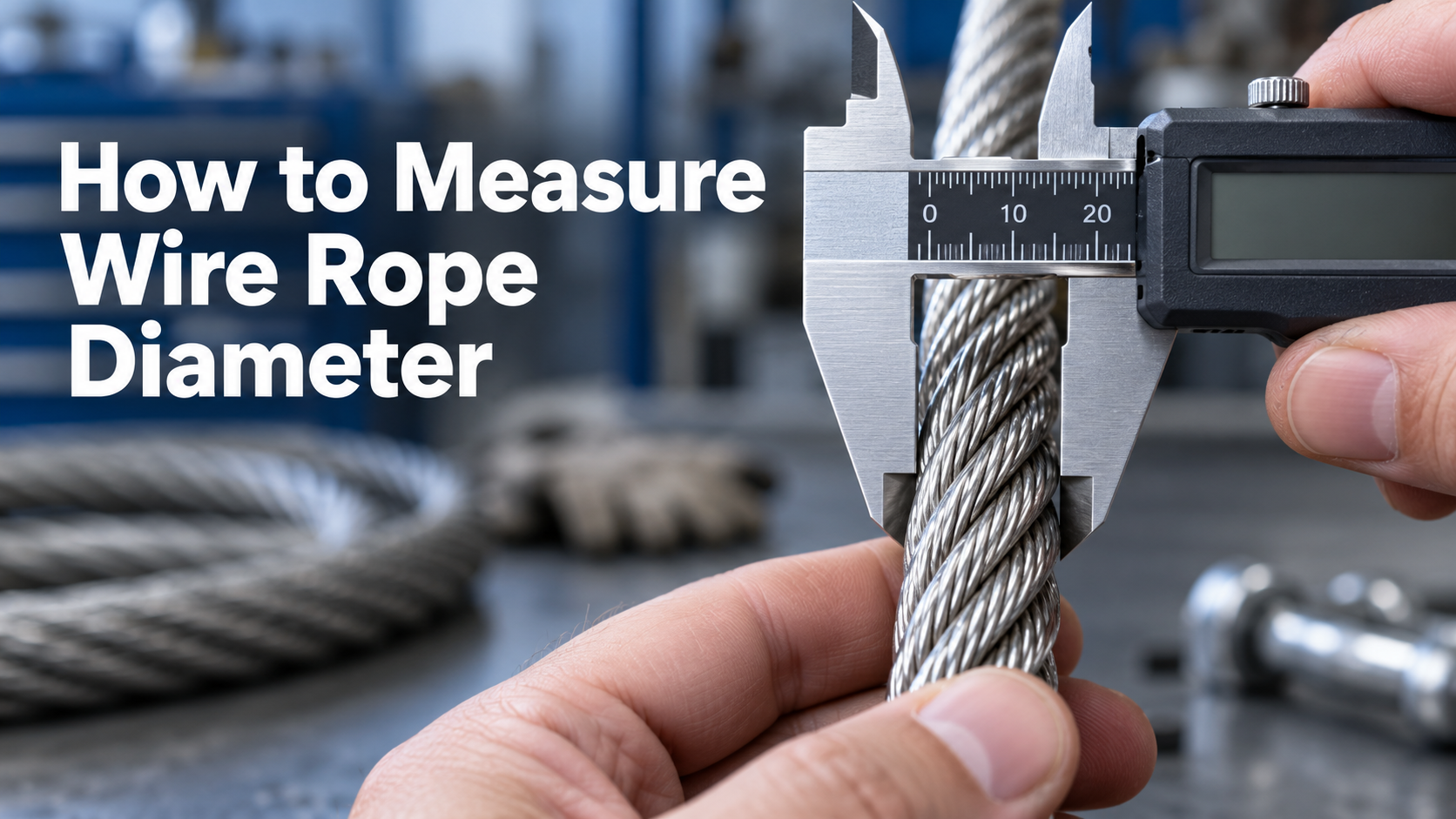
To measure wire rope diameter correctly, use calipers to measure across the crowns (widest points) of the strands — never the valleys. Take two measurements at 90° to each other and average them. The correct diameter is the diameter of the circumscribed circle that just contains the rope's cross-section. Measuring the valleys can under-read by 3–6%, causing you to order undersized rope.
Every wire rope order, replacement, and inspection starts with one number: the diameter. It sets the breaking strength, the fittings that will fit, the sheave groove the rope must run in, and the price per meter. Yet it is also the number buyers and maintenance teams most often get wrong — not because calipers are hard to use, but because a stranded rope is not a round bar, and where you place the jaws changes the answer. This guide shows how to measure wire rope diameter the way rope standards and manufacturers do it, how to handle coated cable, what tolerance to expect on new rope, and exactly what to send a supplier so the replacement matches the original.
Why Measuring Wire Rope Seems Simple (But Isn't)
Hand someone a pair of calipers and a length of rope and they will usually close the jaws wherever they happen to land and read the display. On a solid rod that works. On wire rope it produces a different number depending on how the rope is rotated, because the outer surface is a ring of helical strands with grooves (valleys) between them. The most common mistakes we see on incoming inquiries are:
- Measuring across the valleys. The jaws settle into the grooves between strands and read low. A rope that is really 6mm reads 5.7mm, the buyer orders 5mm or "close enough" stock, and the new rope arrives a size too small.
- Squeezing the jaws. Strands are not rigid; clamping down compresses the rope and knocks another 0.1–0.2mm off the reading.
- Measuring at the end. Near a cut end or a fitting the strands are often loosened, flared, or compressed by seizing and swaging, so the diameter there is not representative.
- Measuring the coating, not the steel. On vinyl- or nylon-coated cable the outside diameter can be 1–2mm larger than the steel inside it — order by the outside reading and the rope's rated strength is wrong by a full size.
- Rounding to the wrong unit system. 6mm and 1/4" (6.35mm) are not the same rope; neither are 3mm and 1/8" (3.18mm). The metric/imperial table below shows which pairs are true equivalents.
The consequences go beyond a return shipment. An undersized rope has less steel in its cross-section, and breaking strength scales with the square of diameter: a 6.0mm rope fitted where a 6.35mm rope was specified carries about 11% less load (see our wire rope breaking strength chart for the full figures). A wrong size also mismatches swaged fittings and sheave grooves — an undersized rope flattens in an oversized groove, an oversized rope pinches in an undersized one — and both shorten service life.
Crown vs Valley: The Critical Difference
The outer strands of a wire rope form a series of high points — the crowns, where each strand stands proud — separated by valleys, the grooves where neighboring strands meet. Rope standards (EN 12385, ISO 2408, GB/T 9944) all define the nominal diameter the same way: the diameter of the circumscribed circle that just encloses the rope's cross-section. That circle touches the crowns, so only a crown-to-crown measurement can read it.
- Crowns = correct. With each caliper jaw resting on the top of a strand on opposite sides of the rope, the reading equals the circumscribed circle — the true diameter. This is the figure every breaking strength table, weight chart, and fitting size is based on.
- Valleys = wrong. When the jaws sit across the grooves, they bridge two strands on each side and stop short of the circle. In practice this under-reads by 3–6%, and on coarse six-strand ropes measured with flat jaws the geometric worst case approaches 9%.
To put 3–6% in real numbers: a 6mm rope measured in the valleys reads roughly 5.65–5.80mm; a 1/4" (6.35mm) rope reads about 0.24"; a 10mm rope can show 9.4mm. Each of those readings points to the next size down. And because the error always goes in the same direction — valleys can only read low — a valley measurement never "averages out"; it systematically sends you to undersized rope.
The fix is simple: use calipers whose jaws are wide enough to bridge at least two adjacent strands, so the jaws are carried by the crowns and cannot drop into a groove. Most standard 150mm (6") digital calipers do this for ropes up to about 12mm; for larger ropes, use broad-jaw calipers or slip a pair of flat gauge plates between the jaws and the rope.
Step-by-Step: Measuring with Calipers
This procedure follows the method EN 12385-1 uses to verify the actual diameter of new rope, adapted for the field. You need calipers with 0.01mm (or 0.001") resolution — vernier or digital — and a straight section of rope. A tape measure or ruler is not accurate enough to distinguish neighboring sizes.
Step 1: Choose a measuring point away from the ends
Pick a straight, undamaged section of rope at least 1 m (3 ft) from a cut end, fitting, or clamp where the length allows; on short assemblies such as gym cables, stay at least a few inches clear of the swaged fittings. Ends are distorted by cutting, seizing, and swaging and will not give a representative reading. If the rope is installed, measure in a section under light tension rather than one lying slack and kinked.
Step 2: Measure across the crowns
Open the jaws, place them across the rope so each jaw rests on the crowns of the strands on opposite sides, and close them gently until they just touch — do not squeeze. Check that the jaws span at least two strands and are not seated in a valley. Record the reading.
Step 3: Rotate 90° and measure again
Turn the calipers a quarter-turn around the rope (or roll the rope 90°) at the same point and take a second crown-to-crown reading. Ropes are rarely perfectly round; two readings at right angles catch any ovality from manufacturing, coiling, or crushing.
Step 4: Average the two readings
Add the two readings and divide by two. That average is the actual diameter at this point. If the two readings differ by more than about 5%, the rope is out of round — note it, since flattening is itself a sign of crushing damage on used rope.
Step 5: Repeat at more points along the rope
Repeat steps 2–4 at two or three positions spaced at least 1 m apart. For a new rope, the overall average is the actual diameter to compare against the nominal size. For a used rope, also keep the smallest average — local thinning is what matters for retirement decisions. Record the readings, the date, and the location on the rope, so the next inspection has a baseline.
A useful cross-check: cut a measured 1 m sample, weigh it, and compare against our stainless steel wire rope weight chart. If your caliper reading says 6mm but the weight matches 5mm, you have either a valley reading or a different construction than you think.
Measuring Coated Wire Rope
Vinyl (PVC) and nylon coated cable has two diameters, and both matter:
- Inside (bare steel) diameter — the diameter of the wire rope under the jacket. This is what sets the breaking strength and what the rope is specified by.
- Outside (coated) diameter — the finished diameter over the jacket. This is what has to fit through pulleys, guides, and the bore of the end fittings.
The coated outside diameter is easy to measure: the jacket is smooth and round, so there are no crowns to worry about, but still take two readings at 90° because coatings can be slightly eccentric. To get the steel diameter, strip 20–30mm of jacket with a sharp knife at a cut end — taking care not to nick the wires — and measure the bare rope across the crowns as above. If you cannot cut the cable, subtract twice the jacket thickness from the coated reading; for most coated cable the jacket adds about 1–1.6mm (roughly 1/16") to the diameter.
Always quote both diameters for coated rope, written bare-first: for example, "7x19, 3/16" bare / 1/4" coated" or "5mm → 6.5mm OD". In the US it is common to see this shortened to "3/16"–1/4"". Giving only one number is the single biggest cause of wrong coated cable orders. Our product range covers PVC and nylon coated 7x7 and 7x19 rope in both sizing systems, and the gym cable replacement guide lists the standard bare/coated pairings used on fitness equipment.
Nominal vs Actual Diameter
The nominal diameter is the size the rope is sold and rated as — 6mm, 1/4", 10mm. The actual diameter is what your calipers read. They are not supposed to be identical: rope standards deliberately allow new rope to be slightly oversize, never undersize.
- EN 12385 and most international practice: −0% / +5% for the common rope sizes. A new 10mm rope should measure between 10.0mm and 10.5mm.
- Small diameters get a wider plus tolerance. Ropes below about 8mm are typically allowed up to +6–8%, because a fixed fraction of a millimeter is a larger percentage of a small rope. Check the governing standard or the mill certificate for the exact figure.
- US practice uses the same convention (−0% on the minus side, a graded plus tolerance that tightens as the rope gets larger).
The reason ropes run oversize is that a new rope compacts slightly under its first loads — the strands bed into the core and the diameter settles. A rope that started at exactly nominal would end up undersize after a few cycles. Two practical consequences:
- A new rope that measures under nominal is out of spec, even by 0.1mm — or it was measured in the valleys. Re-measure across the crowns before rejecting it.
- A new rope that measures 3–5% over nominal is normal. A "6mm" rope reading 6.2mm is a 6mm rope, not a 1/4" rope. Don't up-size your order based on it.
Common Sizes Reference: Metric & Imperial
Metric and imperial rope are made to different nominal sizes, and only some pairs are true equivalents. Within about ±1% the two are interchangeable; at ±5% they are different ropes with different strengths and fittings. Use this table to read a caliper result in either system and find the nearest stock size:
| Metric size | In inches (decimal) | Closest imperial size | Difference |
|---|---|---|---|
| 0.4 mm | 0.016" | 1/64" (0.40 mm) | +0.8% — equivalent |
| 0.5 mm | 0.020" | none (between 1/64" and 1/32") | order metric |
| 0.8 mm | 0.031" | 1/32" (0.79 mm) | +0.8% — equivalent |
| 1.0 mm | 0.039" | none (between 1/32" and 3/64") | order metric |
| 1.2 mm | 0.047" | 3/64" (1.19 mm) | +0.8% — equivalent |
| 1.5 mm | 0.059" | 1/16" (1.59 mm) | −5.5% — not equivalent |
| 1.6 mm | 0.063" | 1/16" (1.59 mm) | +0.8% — equivalent |
| 2.0 mm | 0.079" | 5/64" (1.98 mm) | +0.8% — equivalent |
| 2.4 mm | 0.094" | 3/32" (2.38 mm) | +0.8% — equivalent |
| 3.0 mm | 0.118" | 1/8" (3.18 mm) | −5.5% — not equivalent |
| 3.2 mm | 0.126" | 1/8" (3.18 mm) | +0.8% — equivalent |
| 4.0 mm | 0.157" | 5/32" (3.97 mm) | +0.8% — equivalent |
| 4.8 mm | 0.189" | 3/16" (4.76 mm) | +0.8% — equivalent |
| 5.0 mm | 0.197" | 3/16" (4.76 mm) | +5.0% — not equivalent |
| 6.0 mm | 0.236" | 1/4" (6.35 mm) | −5.5% — not equivalent |
| 6.4 mm | 0.252" | 1/4" (6.35 mm) | +0.8% — equivalent |
| 8.0 mm | 0.315" | 5/16" (7.94 mm) | +0.8% — equivalent |
| 9.5 mm | 0.374" | 3/8" (9.53 mm) | −0.3% — equivalent |
| 10 mm | 0.394" | 3/8" (9.53 mm) | +5.0% — not equivalent |
| 12 mm | 0.472" | 1/2" (12.70 mm) | −5.5% — not equivalent |
| 13 mm | 0.512" | 1/2" (12.70 mm) | +2.4% — close |
| 16 mm | 0.630" | 5/8" (15.88 mm) | +0.8% — equivalent |
| 19 mm | 0.748" | 3/4" (19.05 mm) | −0.3% — equivalent |
| 20 mm | 0.787" | 3/4" (19.05 mm) | +5.0% — not equivalent |
The rows marked "not equivalent" are where most mix-ups happen. 3mm vs 1/8", 6mm vs 1/4", and 10mm vs 3/8" are each about 5% apart in diameter — which is roughly 10–11% apart in breaking strength. If your caliper reading lands between two stock sizes, it is almost always the larger one measured in the valleys, or the smaller one at the top of its plus tolerance; re-measure across the crowns and check the weight before deciding.
When Rope Diameter Loss Means Retirement
In service, wire rope gets thinner: outer wires wear against sheaves and drums, the core compacts or deteriorates, and corrosion eats metal from the inside. Diameter is therefore one of the key discard criteria. The widely used rule, and the one in our wire rope inspection checklist, is to retire the rope when its diameter has dropped more than 5% from its original diameter at any point along its length.
The key word is original. Because new rope is made up to 5% oversize, comparing a worn rope against its nominal size hides real wear. ISO 4309, the discard standard for crane ropes, addresses this by comparing against a reference diameter measured when the rope is first put into service. Worked example for a 6mm rope:
- Measured when new: 6.20mm → retire below 6.20 × 0.95 = 5.89mm.
- No baseline, so measured against nominal: 6.00 × 0.95 = 5.70mm — which would allow the rope to lose 8% of its real diameter before being flagged.
That is why Step 5 above says to record your readings: the first measurement of a new rope is the most valuable one you will ever take. Beyond the overall percentage, watch for:
- Localized thinning — a short section noticeably thinner than the rope on either side usually means a crushed spot or a failed core. Treat it as a discard condition even if the reduction is under 5%.
- Diameter increase — a section that has grown is just as serious; it typically signals internal corrosion, core swelling, or the start of bird-caging.
- Rapid change — if successive inspections show the diameter falling faster than before, shorten the inspection interval and plan replacement.
Ordering the Right Size
A diameter alone is not a rope specification. To get an exact match — or an accurate quote — on the first try, send your supplier:
- Construction — 1x19, 7x7, 7x19, etc. Count the strands at a cut end and the wires in one strand. If you're unsure which fits your application, see our guide on how to choose stainless steel wire rope.
- Diameter — the crown-to-crown measurement, stating mm or inches, and whether it is nominal or measured. For coated rope, give both bare and coated diameters.
- Material grade — 304 or 316 stainless (or galvanized), plus coating type and color if applicable.
- Length — per piece for cut-to-length assemblies, or total length on reels. For assemblies, state whether length is measured end-to-end or bearing-to-bearing.
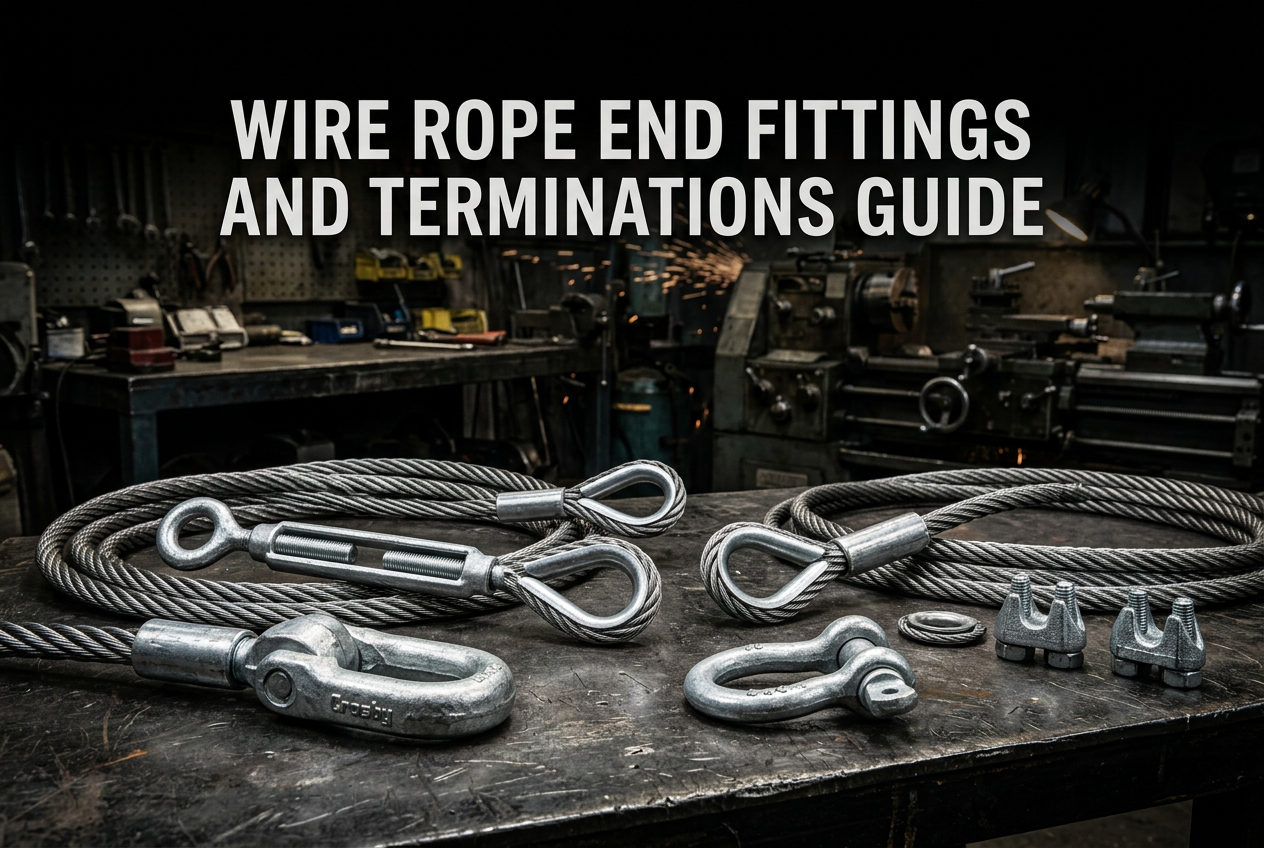
- End terminations — fitting type and size for each end (swaged eye, thimble eye, stud, button, ball, etc.). Our wire rope end fittings guide shows the common types and how they are sized to the rope.
- Quantity and application — and the working load or minimum breaking strength required, so the supplier can confirm the size is adequate, not just matching.
If you're replacing an existing rope, a photo of the calipers on the rope and a close-up of a cut end showing the strands removes almost all ambiguity. A short sample works even better.
Frequently Asked Questions
How do you measure wire rope diameter?
Use calipers and measure across the crowns — the outermost points of the strands on opposite sides of the rope — never across the valleys between them. Take a second reading at 90° to the first and average the two. Repeat at two or three points at least 1 m apart and away from the ends. The result is the diameter of the circle that just encloses the rope, which is how wire rope is sized.
What is the tolerance on wire rope diameter?
New wire rope is made to a −0% / +5% tolerance under EN 12385 for most common sizes, meaning it may measure up to 5% over nominal but never under. Small diameters below about 8mm are typically allowed a slightly larger plus tolerance (up to around +6–8%). A new rope that measures under its nominal size is out of specification.
Do you measure wire rope over the crowns or valleys?
Over the crowns. The nominal diameter of wire rope is defined as the circumscribed circle touching the outermost strands, so only a crown-to-crown measurement reads it. Measuring across the valleys between strands under-reads by about 3–6% and leads to ordering rope one size too small. Use calipers with jaws wide enough to span at least two strands.
How do you measure coated wire rope?
Measure two diameters. The coated outside diameter is read directly over the jacket. The bare steel diameter is measured across the crowns after stripping a short length of jacket at a cut end, or estimated by subtracting the jacket thickness (usually about 1–1.6mm in total) from the coated reading. Wire rope is rated and ordered by the bare diameter, so always quote both — for example 3/16" bare / 1/4" coated.
Is 6mm wire rope the same as 1/4 inch?
No. 1/4" is 6.35mm, so 6mm rope is about 5.5% smaller in diameter and roughly 11% lower in breaking strength. Fittings sized for one may not swage correctly on the other. The true metric equivalent of 1/4" is 6.4mm; likewise 1/8" matches 3.2mm, not 3mm.
Measure Once, Order Right
A correct crown-to-crown measurement, the construction, and the length are all we need to quote an exact replacement. Send your measurements — or a photo of the rope and its fittings — and our engineering team will confirm the size, check it against your load requirement, and typically respond within 2 hours during business hours.