Quick Answer
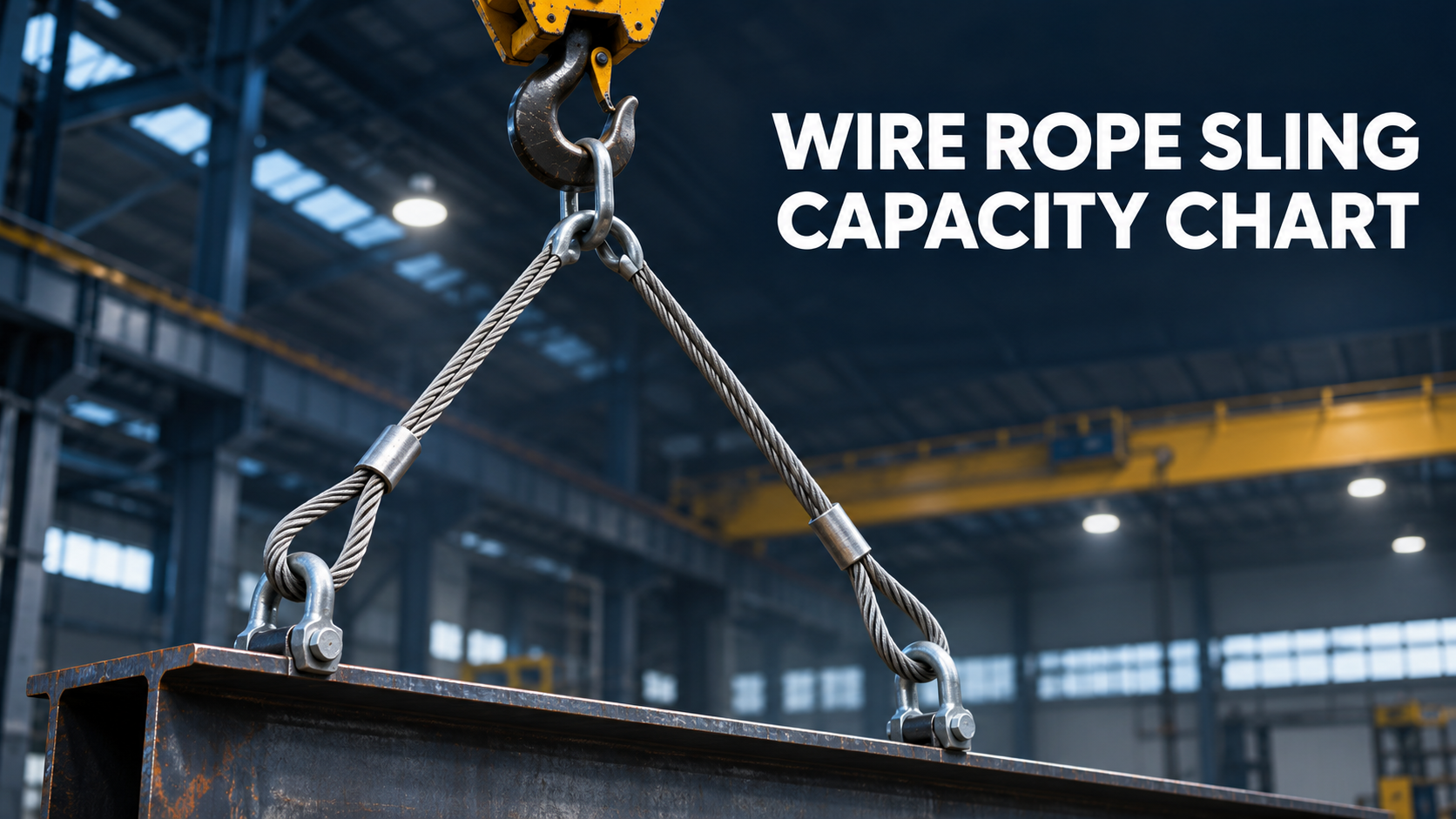
Wire rope sling capacity depends on three things: rope diameter/grade, hitch type, and sling angle. A vertical hitch uses 100% of rated capacity, a choker hitch roughly 75%, and a basket hitch up to 200% (at 90°). As the sling angle drops from 90° to 30°, capacity falls by half. Always apply a 5:1 design factor per ASME B30.9.
How Sling Capacity Is Calculated
Every wire rope sling rating starts from the same number: the minimum breaking strength (MBS) of the rope it is made from. The rated load of a single sling leg — its working load limit (WLL) — is that breaking strength divided by the design factor. For wire rope slings, ASME B30.9 and EN 13414-1 both set the design factor at 5:1:
Single-leg rated load (WLL) = MBS ÷ 5
Everything else in this guide is a multiplier applied to that single-leg figure. The hitch type changes how the rope carries the load (a choker loses capacity at the choke point; a basket shares the load between two legs), and the sling angle changes how much of each leg's tension actually lifts the load rather than pulling sideways. The final capacity of a rig is:
Rig capacity = Single-leg WLL × Hitch factor × Angle factor
The breaking strength itself depends on diameter, construction class, core type, and tensile grade. Our wire rope breaking strength formula guide explains how MBS = d² × K × R is derived, and the wire rope working load limit guide covers safety factors for non-sling applications such as winch lines, guy wires, and personnel lifting.
One further point: a sling's tagged rating is not always exactly MBS ÷ 5. Manufacturers also account for the efficiency of the eye termination — a mechanical (ferrule-secured) splice typically retains 90–95% of rope strength, a hand splice somewhat less — so published sling tables often sit a few percent below the raw rope figure. The sling tag is the rating that counts.
The Three Basic Hitches
The same sling can lift very different loads depending on how it is rigged. These are the three basic hitches and the capacity each one gives you relative to the sling's vertical rating.
Vertical Hitch — 100% of Rated Capacity
In a vertical (straight) hitch, one eye goes on the hook and the other attaches directly to the load, usually through a shackle or lifting lug. The full rated capacity of the sling is available because the rope carries the load in a straight line with no bending at the load.
- Use it for: loads with a single, centered lifting point — engine blocks, pump skids with a top lug, test weights, spreader beams.
- Watch out for: load rotation. A single vertical leg gives no control over spin, and rotation can unlay the rope. Use a tag line, and never use a single vertical hitch on a load that is long or unstable.
Choker Hitch — Roughly 75% of Rated Capacity
In a choker hitch, the sling wraps around the load and passes through its own eye (or through a choker hook or shackle), so it tightens as the load is lifted. The sharp bend where the rope passes through the eye, and the uneven load sharing it causes, reduce capacity to about 75% of the vertical rating for IWRC wire rope slings under ASME B30.9 (EN 13414-1 uses a factor of 0.8).
- Use it for: bundles of pipe, bar stock, and timber; cylindrical loads with no lifting points; any load where the sling must grip.
- Watch out for: the choke angle. The 75% figure assumes a choke angle of 120° or more. A tighter choke reduces capacity further — see the choker de-rating table below. Never let the choke point sit on the edge of a load, and never hammer the eye down to tighten it.
Basket Hitch — Up to 200% of Rated Capacity
In a basket hitch, the sling cradles the load with both eyes on the hook. Two legs share the load, so a basket with vertical legs (90° from horizontal) carries up to twice the vertical rating. As soon as the legs spread out, the angle factor applies and the capacity drops below 200%.
- Use it for: loads that can be balanced and cradled — drums, reels, rolls, boxed machinery, and loads where you need to avoid point loading.
- Watch out for: balance and bend radius. A basket does not grip the load, so an unbalanced load can slide out. The rope must also bend around a diameter of at least 25 times the rope diameter (D/d ≥ 25) to keep the full basket rating; tighter bends cut capacity, which is why padding and saddles matter on small-diameter loads.
Sling Capacity Chart — Single Leg
The table below gives the rated load of a single-leg wire rope sling in each of the three basic hitches. Values are calculated from the minimum breaking force of 6x19 or 6x37 class rope with an IWRC in 1960 MPa grade (MBS = d² × 0.356 × 1960 ÷ 1000, per EN 12385-4), divided by the 5:1 design factor. The two classes have the same breaking force at a given diameter, so one chart covers both — see our 6x19 vs 6x37 wire rope comparison for why. For core options and why sling rope is normally IWRC, see our guide to wire rope core types (FC, IWRC, WSC).
| Rope Diameter (mm) | Min. Breaking Force (kN) | Vertical — 100% | Choker — 75% | Basket (vertical legs) — 200% |
|---|---|---|---|---|
| 6 (≈1/4") | 25.1 | 0.51 t / 1,129 lbs | 0.38 t / 847 lbs | 1.02 t / 2,259 lbs |
| 8 (≈5/16") | 44.7 | 0.91 t / 2,008 lbs | 0.68 t / 1,506 lbs | 1.82 t / 4,016 lbs |
| 10 (≈3/8") | 69.8 | 1.42 t / 3,137 lbs | 1.07 t / 2,353 lbs | 2.85 t / 6,275 lbs |
| 12 (≈1/2") | 100.5 | 2.05 t / 4,518 lbs | 1.54 t / 3,388 lbs | 4.10 t / 9,035 lbs |
| 14 (≈9/16") | 136.8 | 2.79 t / 6,149 lbs | 2.09 t / 4,612 lbs | 5.58 t / 12,298 lbs |
| 16 (≈5/8") | 178.6 | 3.64 t / 8,031 lbs | 2.73 t / 6,024 lbs | 7.29 t / 16,063 lbs |
| 18 (≈11/16") | 226.1 | 4.61 t / 10,165 lbs | 3.46 t / 7,624 lbs | 9.22 t / 20,329 lbs |
| 20 (≈3/4") | 279.1 | 5.69 t / 12,549 lbs | 4.27 t / 9,412 lbs | 11.38 t / 25,098 lbs |
| 22 (≈7/8") | 337.7 | 6.89 t / 15,184 lbs | 5.17 t / 11,388 lbs | 13.77 t / 30,369 lbs |
| 24 (≈15/16") | 401.9 | 8.20 t / 18,071 lbs | 6.15 t / 13,553 lbs | 16.39 t / 36,141 lbs |
| 26 (≈1") | 471.7 | 9.62 t / 21,208 lbs | 7.21 t / 15,906 lbs | 19.24 t / 42,416 lbs |
| 28 (≈1-1/8") | 547.0 | 11.16 t / 24,596 lbs | 8.37 t / 18,447 lbs | 22.31 t / 49,192 lbs |
Typical values, verify with sling tag. Capacities are rope-based (MBS ÷ 5) and do not include termination efficiency; t = metric tonnes (1,000 kgf). Imperial sizes are the nearest equivalent to each metric diameter, not exact conversions — an imperial-sized rope will have a slightly different rating. For 1770 MPa grade rope, multiply by about 0.90; for fiber core (FC) rope, multiply by about 0.93.
These figures are for carbon steel 6-strand sling rope. Smaller stainless constructions such as 7x7 and 7x19 have their own breaking strength tables — see the full wire rope breaking strength chart and divide by 5 to get a vertical single-leg rating.
Sling Angle Factor
Sling angle is the angle between a sling leg and the horizontal. When legs spread out from vertical, each leg must pull partly sideways against the other leg, so the tension in each leg rises above its share of the load. The angle factor is the sine of the sling angle:
| Sling Angle (from horizontal) | Angle Factor (capacity retained) | Tension per Leg (× share of load) |
|---|---|---|
| 90° (vertical legs) | 1.000 (100%) | 1.00× |
| 60° | 0.866 (87%) | 1.15× |
| 45° | 0.707 (71%) | 1.41× |
| 30° | 0.500 (50%) | 2.00× |
| Below 30° | Not permitted without approval from the sling manufacturer or a qualified person | |
To use the table, multiply the basket or multi-leg capacity by the angle factor. A 12 mm sling in a basket hitch is rated 4.10 t with vertical legs; at a 60° sling angle it is rated 4.10 × 0.866 = 3.55 t, and at 30° only 2.05 t — the same as a single vertical leg.
Why angles below 30° are prohibited. The angle factor falls faster the flatter the sling gets. At 30° each leg already carries the full weight of the load; at 20° each leg carries 1.46 times the load, and at 10° nearly three times. At these angles a few degrees of measurement error — or the load shifting slightly — makes a large difference in leg tension, and the horizontal pull on the lifting points can bend lugs or crush the load. ASME B30.9 does not allow horizontal sling angles below 30° unless the sling manufacturer or a qualified person approves the lift. If the headroom is too low for a 30° angle, use longer slings or a spreader beam.
Note: some references, including our WLL guide, measure the angle from vertical instead. 60° from horizontal is the same as 30° from vertical — check which convention a chart uses before reading it.
Two-Leg & Multi-Leg Bridle Slings
A bridle sling has two, three, or four legs joined at a master link on the hook. Bridles give much better load control than a single leg, but their capacity depends heavily on angle and on how evenly the legs share the load.
Two-Leg Bridle
Two-leg capacity = Single-leg WLL × 2 × Angle factor
Example: a two-leg bridle made from 16 mm 6x19 IWRC rope. Each leg is rated 3.64 t vertical (from the chart above).
- At a 60° sling angle: 3.64 × 2 × 0.866 = 6.30 t
- At a 45° sling angle: 3.64 × 2 × 0.707 = 5.15 t
- At a 30° sling angle: 3.64 × 2 × 0.500 = 3.64 t — no more than a single vertical leg
If the load's center of gravity is not centered between the lifting points, the legs will not share the load equally, and the shorter or steeper leg carries more. Calculate each leg's tension separately for off-center loads.
Three-Leg and Four-Leg Bridles
In theory, three and four legs should multiply capacity by three and four. In practice, a rigid load sitting on four points rarely touches all four evenly — small differences in leg length or lug position mean two legs can end up carrying most of the weight. Standards handle this conservatively:
- ASME B30.9 rates a three-leg bridle at 3 × single-leg WLL × angle factor, and gives a four-leg bridle the same rating as a three-leg bridle — the fourth leg adds stability, not capacity.
- EN 13414-1 uses fixed multipliers for multi-leg slings with angles measured from vertical: two legs 1.4 (0–45°) or 1.0 (45–60°); three and four legs 2.1 (0–45°) or 1.5 (45–60°).
- Many site rules go further and require that only two legs be counted on any rigid load unless a load-equalizing arrangement is used. When in doubt, assume two.
Example: a four-leg bridle in 12 mm rope (2.05 t per leg) at a 60° sling angle, rated as a three-leg under ASME: 2.05 × 3 × 0.866 = 5.33 t. Under the two-leg site rule it would be 2.05 × 2 × 0.866 = 3.55 t.
Choker Hitch De-rating Details
The 75% choker figure assumes a choke angle of 120° or more — that is, the sling leaves the choke point at a gentle angle. When the choke is pulled tighter, the rope bends more sharply at the eye and capacity falls further. ASME B30.9 gives the following reductions, applied to the standard choker rating:
| Angle of Choke | Choker Rated Load Retained | Equivalent % of Vertical Rating |
|---|---|---|
| 120°–180° | 100% | ≈75% |
| 90°–119° | 87% | ≈65% |
| 60°–89° | 74% | ≈56% |
| 30°–59° | 62% | ≈47% |
| 0°–29° | 49% | ≈37% |
Example: a 12 mm sling has a choker rating of 1.54 t. Pulled down to a 75° choke angle, it retains 74% of that: 1.54 × 0.74 = 1.14 t — barely more than half its vertical rating.
Two more rules for chokers: let the choke settle naturally rather than forcing it down, and if you choke a sling through a shackle, put the shackle pin on the eye side and the bow against the rope that runs through it, so the moving rope bears on the smooth bow rather than turning the pin. Two chokers used together as a pair are also subject to the sling angle factor.
Sling Inspection & Rejection Criteria
A sling's rated capacity only applies while it is in serviceable condition. ASME B30.9 requires an initial inspection before first use, a visual check by the user before every use, and a documented periodic inspection by a competent person at least once a year (more often in severe service). Remove a wire rope sling from service when you find:
- Missing or illegible identification tag — without the tag, the rated load is unknown and the sling must not be used.
- Broken wires: for strand-laid slings, ten randomly distributed broken wires in one rope lay, or five broken wires in one strand in one rope lay.
- Severe localized abrasion or scraping, or a reduction in rope diameter from wear.
- Kinking, crushing, birdcaging, or any other distortion of the rope structure.
- Heat damage — discoloration, weld spatter, or arc strikes.
- Damaged end attachments: cracked, deformed, or worn ferrules, sockets, or thimbles; hooks opened more than 15% of the normal throat or twisted more than 10°.
- Severe corrosion of the rope or end attachments, especially pitting.
- Core protrusion between the outer strands.
For a step-by-step procedure, including how to count broken wires per lay length and measure diameter correctly, use our wire rope inspection checklist.
Stainless Steel Slings for Corrosive Environments
Galvanized carbon steel is the default sling material, but some environments destroy it quickly — and corrosion reduces breaking strength long before it is obvious on the surface. Stainless steel wire rope slings are the standard choice for:
- Food and beverage plants — 304 stainless slings tolerate washdown chemicals and steam cleaning, and they shed no zinc or rust onto product or equipment.
- Offshore and marine work — 316 stainless resists chloride pitting from salt spray and seawater immersion far better than 304 or galvanized rope. See our guide to stainless steel wire rope in marine applications.
- Chemical, pharmaceutical, and water treatment plants — 316 handles acids, chlorinated water, and process vapors, and is easy to keep clean.
Note that stainless rope is usually produced in 1570–1770 MPa grades rather than 1960 MPa, so a stainless sling of the same diameter typically has a 10–20% lower rating than the carbon steel chart above. Size up one diameter, or ask for the rated load from the manufacturer. Our 304 vs 316 comparison explains which grade suits which environment.
Qianjun manufactures 304 and 316 stainless steel wire rope in 7x7, 7x19, 6x19, and 6x37 constructions with IWRC, and supplies cut lengths with swaged or ferrule-secured eyes for sling makers. Browse our product range or see the full specifications.
Relevant Standards
- ASME B30.9 — the US standard for slings. Sets the 5:1 design factor for wire rope slings, the hitch and angle rating method, choker de-rating, tagging, and inspection and removal criteria.
- EN 13414 — the European standard for steel wire rope slings. Part 1 covers slings for general lifting service, including the 0.8 choker factor and multi-leg mode factors; Part 2 covers information for use and maintenance.
- ISO 8792 — wire rope slings: safety criteria and inspection procedures for use.
Rope-level standards such as EN 12385-4 (stranded ropes for general lifting) and ISO 2408 define the breaking force that sling ratings are built on. Where more than one standard applies, follow the stricter one.
Frequently Asked Questions
How much can a wire rope sling lift?
It depends on the rope diameter, grade, hitch, and sling angle. A single-leg 12 mm (≈1/2") 6x19 IWRC sling in 1960 MPa grade is rated about 2.05 t (4,518 lbs) in a vertical hitch, 1.54 t (3,388 lbs) in a choker hitch, and 4.10 t (9,035 lbs) in a basket hitch with vertical legs. Always use the rating on the sling tag.
What is the capacity of a choker hitch?
A choker hitch is rated at about 75% of the sling's vertical capacity under ASME B30.9 (80% under EN 13414-1), as long as the choke angle is 120° or more. Tighter choke angles reduce capacity further, down to 49% of the choker rating at angles below 30°.
Why does sling angle reduce capacity?
When a sling leg is not vertical, part of its tension pulls sideways instead of lifting. The leg tension rises as the angle flattens: at a 60° sling angle each leg carries 1.15 times its share of the load, at 45° it carries 1.41 times, and at 30° it carries twice its share. So the same sling lifts less as the angle drops — half as much at 30° as at 90°.
Is a basket hitch always double the vertical capacity?
No. A basket hitch reaches 200% of the vertical rating only when both legs are vertical (90°) and the rope bends around a load at least 25 times its own diameter. At a 60° sling angle it is rated about 173%, at 45° about 141%, and at 30° only 100%.
Do stainless steel wire rope slings have the same capacity as galvanized?
Not usually. Stainless rope is typically made in 1570–1770 MPa grade, while carbon steel sling rope is often 1960 MPa, so a stainless sling of the same diameter is generally rated 10–20% lower. Stainless is chosen for corrosion resistance in food, marine, and chemical environments, not for extra strength.
Need Sling Rope or Pre-Made Sling Legs?
We supply 6x19 and 6x37 class rope with IWRC in galvanized, bright, and 304/316 stainless steel, with mill test certificates for every lot. Tell us the diameter, construction, length, and end terminations you need and we will quote factory-direct pricing — or contact our engineering team for help sizing a sling for your load.