Quick Answer
Steel wire rope wins on abrasion resistance, heat tolerance, UV immunity and price; synthetic (UHMWPE/Dyneema-type) wins on weight (about 80% lighter), safer failure behavior and easy field handling. For recovery winching on rocks and drum heat, steel lasts longer. For frequent handling and safety-critical recreation use, synthetic is preferred — but must be inspected for abrasion and replaced more often.
The Two Contenders
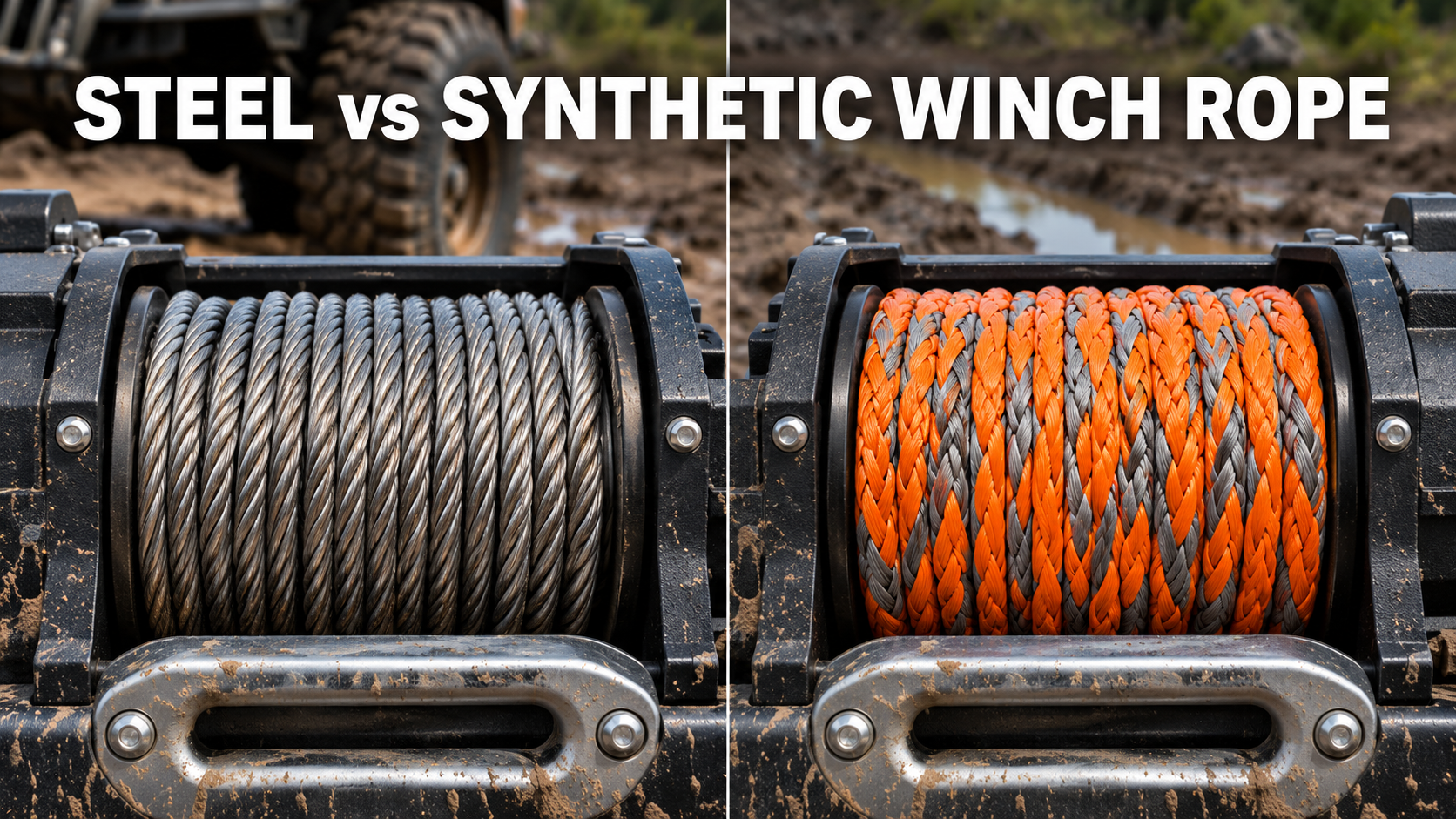
Every winch line does the same job — transfer the winch's pull to the load — but steel cable and synthetic rope do it with very different materials.
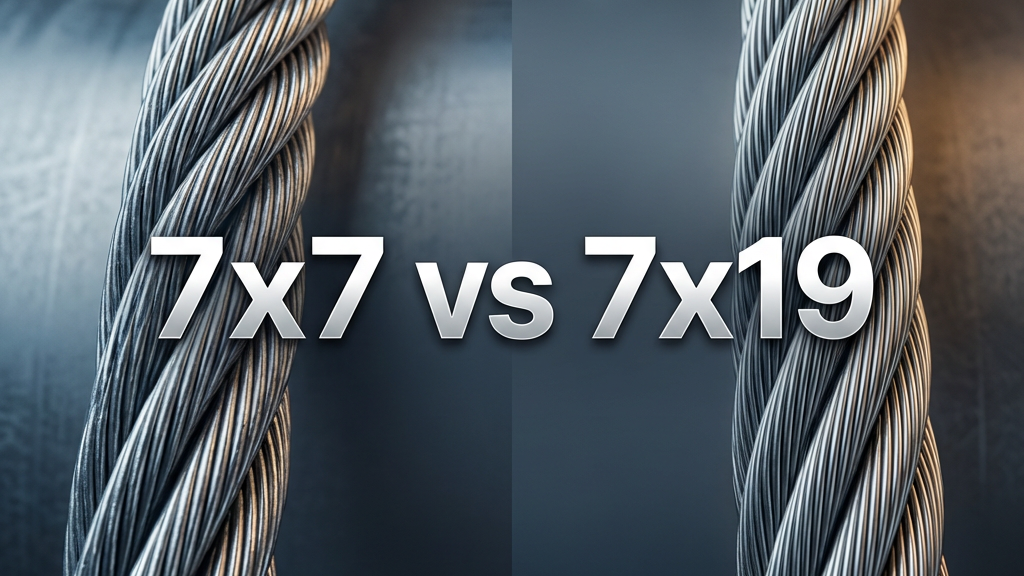
- Steel wire rope (winch cable): Most vehicle and utility winches ship with a galvanized steel 7x19 rope — 7 strands of 19 wires each — because its fine wires bend around a small drum without fatiguing quickly. Larger recovery and industrial winches often use 6x19 IWRC: six strands around an independent wire rope core, which resists crushing when the rope is spooled in many layers under load. Our 7x7 vs 7x19 construction guide explains why the higher wire count matters on a drum.
- Synthetic winch rope: Braided from ultra-high-molecular-weight polyethylene (UHMWPE) fibers, sold under trade names such as Dyneema® and Spectra®. Most winch lines are a 12-strand single braid, often with a coating to slow abrasion and UV damage, and a chafe sleeve near the hook. The fiber has a density of about 0.97 g/cm³, so the rope floats.
Both can be made strong enough for any common winch. The real differences are in how they wear, how they handle heat and sunlight, how they fail, and what they cost.
Head-to-Head Comparison Table
The table scores each material from 1 (poor) to 5 (excellent) on the factors that decide which line you should run.
| Factor | Steel Wire Rope | Synthetic (UHMWPE) | Winner |
|---|---|---|---|
| Strength-to-weight ratio | 2/5 — heavy for its strength | 5/5 — about 80% lighter at equal strength | Synthetic |
| Abrasion resistance | 5/5 — tolerates rock, bed edges, dragging | 2/5 — cuts and fuzzes on sharp edges | Steel |
| Heat tolerance | 5/5 — unaffected by drum and brake heat | 2/5 — weakens above ~70 °C, melts near 150 °C | Steel |
| UV resistance | 5/5 — immune to sunlight | 3/5 — fibers and coating degrade slowly in sun | Steel |
| Recoil safety if it breaks | 2/5 — heavy line can whip back | 4/5 — light line tends to drop | Synthetic |
| Service life | 4/5 — years with basic care | 3/5 — shorter under abrasion and sun | Steel |
| Price | 5/5 — lowest cost per meter | 2/5 — typically 2–3× the cost of steel | Steel |
| Maintenance & handling | 3/5 — gloves needed, kinks, burrs | 4/5 — no burrs, field-spliceable, but wash and inspect often | Synthetic |
In short: steel scores higher on durability and cost, synthetic on weight and handling. Which matters more depends on where — and how often — you winch.
Strength & Stretch
At the same diameter, a quality UHMWPE winch line is roughly as strong as or stronger than galvanized steel cable. For reference, a 10 mm (3/8") 7x19 steel rope has a minimum breaking force of about 69.6 kN (15,600 lbs) in 1770 MPa grade, and an 8 mm (5/16") rope about 44.5 kN (10,000 lbs) — see the full wire rope breaking strength chart for every size. A 3/8" synthetic line from a reputable maker is usually rated in the same range or higher. Raw strength is rarely the deciding factor.
The bigger difference is what happens when the line fails. Any rope under load stretches and stores elastic energy, like a spring. Steel wire rope stretches only about 0.5–1% at working load, but it is heavy: a 30 m length of 10 mm cable weighs around 12 kg. When it breaks, that stored energy goes into a heavy, stiff line, which can whip back toward the winch or across the recovery area with enough force to break glass and injure people.
Synthetic rope stores energy too — it is not recoil-free — but it carries very little mass. When it parts, the light, limp line has little momentum, slows quickly in the air, and usually drops to the ground within a short distance. That is the real safety advantage: low mass, not zero stored energy. For either line, keep bystanders out of the danger zone (at least 1.5 times the length of the deployed line), and drape a winch dampener or heavy blanket over the middle of the line during every pull.
Where Steel Wins
Steel cable is still the standard on most tow trucks, rollback beds, industrial winches, and hard-use recovery rigs, for good reasons:
- Rock and rough-edge abrasion: Dragging a line over granite, tree roots, bumper edges, or a rollback deck wears steel slowly and visibly. The same contact can cut a synthetic line in a single pull.
- Drum heat: Many vehicle winches have the brake inside the drum. On long or repeated pulls the drum can get hot enough to weaken UHMWPE fibers in the inner wraps. Steel does not care.
- UV exposure: A winch spooled on a front bumper sits in the sun all year. Steel is unaffected; synthetic needs a cover to slow fiber and coating damage.
- Long-term static use: For lines that stay under tension for long periods, such as tie-downs, anchor lines, or semi-permanent rigging, steel does not creep. UHMWPE slowly lengthens under sustained load.
- Low cost: Steel cable costs a fraction of synthetic, which matters for fleets that replace lines regularly.
This is why the towing and recovery industry and industrial usersrun steel. A wrecker or rollback cable is dragged under cars, over deck edges, and through mud dozens of times a week; a capstan or utility winch pulls daily in all weather. In those duty cycles, a cheap, abrasion-tolerant, heat-proof line that shows wear before it fails is the practical choice.
Where Synthetic Wins
- Weight: Synthetic is about 80% lighter. On a typical 9,500 lb winch with 30 m of line, that can mean 10 kg or more off the front of the vehicle — and a line you can carry up a hill without struggling.
- It floats: UHMWPE is lighter than water, so a line pulled through a river crossing or used near boats stays visible and easy to retrieve.
- Bare-hand handling: No broken-wire burrs ("meat hooks"), no kinks that permanently damage the rope, and easy field splicing if it is cut. Many recreational users simply find it more pleasant to use.
- Safer failure: As explained above, a broken synthetic line usually drops rather than whips, which is why many off-road clubs and competition events prefer or require it.
If you switch from steel to synthetic, replace the roller fairlead with a smooth hawse fairlead (steel cable leaves burrs on rollers that will cut synthetic), and check whether your winch maker approves synthetic rope with its drum brake design.
Winch Cable Sizing Guide
The table below shows common steel cable sizes by winch rating. Breaking forces are approximate minimums for 7x19 rope in 1770 MPa grade; 6x19 IWRC in a 1960 MPa grade is similar or slightly higher at the same diameter.
| Winch Rated Line Pull | Typical Use | Rope Diameter | Construction | Approx. Min. Breaking Force |
|---|---|---|---|---|
| 2,000–2,500 lbs | Small ATV, utility, boat trailer | 5 mm (3/16") | 7x19 | ≈3,900 lbs (17.4 kN) |
| 3,000–3,500 lbs | ATV / UTV | 5.5–6 mm (7/32"–1/4") | 7x19 | ≈4,700–5,600 lbs |
| 4,500–5,000 lbs | UTV, trailer, light utility | 6 mm (1/4") | 7x19 | ≈5,600 lbs (25.1 kN) |
| 8,000 lbs | Mid-size 4x4 | 8 mm (5/16") | 7x19 | ≈10,000 lbs (44.5 kN) |
| 9,500 lbs | Full-size 4x4, pickup | 8–9.5 mm (5/16"–3/8") | 7x19 or 6x19 IWRC | ≈10,000–14,100 lbs |
| 10,000–12,000 lbs | Heavy truck, recovery, utility | 9.5–10 mm (3/8") | 6x19 IWRC or 7x19 | ≈14,100–15,600 lbs |
Three rules when using this table:
- Never go thinner than the winch maker specifies. The rated line pull applies on the first layer of the drum, where pull is highest, and the rope must be at least that strong.
- A thicker rope means less length on the drum. Moving from 8 mm to 10 mm reduces drum capacity by roughly a third, so check the drum before upsizing.
- Use a snatch block for heavy pulls. Doubling the line roughly halves the load on each leg and gives a larger safety margin than upsizing the rope.
Galvanized vs Stainless for Winch Lines
Most steel winch cable is galvanized, and for inland vehicles that is fine. But winch rope spends its life wet, muddy, and spooled tight on a drum, and spooling under load scrapes the zinc off the outer wires. Once the zinc is gone, the inner wraps rust where you cannot see them.
Stainless steel wire rope is worth the extra cost where water and salt are constant:
- 304 stainless: Freshwater, wet climates, and vehicles that sit outdoors for long periods. Resists general rusting well.
- 316 stainless: Boat trailer winches, boat lifts, beach and coastal recovery, and any line exposed to road salt or seawater. The molybdenum in 316 resists chloride pitting.
Stainless rope is usually produced in 1570–1770 MPa grades, so compare its breaking force with the winch rating rather than assuming it matches galvanized at the same diameter. For a full comparison of coatings, lifespans, and costs, see stainless steel vs galvanized wire rope.
Maintenance & Inspection for Steel Winch Lines
A steel winch line gives warnings before it fails — if you look. After every recovery, and at least every few months on an idle winch:
- Re-spool under tension. Rope wound loosely after a pull will be crushed and buried by the next loaded pull. Spool it back with a light load — even a few hundred kilograms — in neat, even wraps.
- Keep at least five wraps on the drum. The drum anchor is not designed to hold the load; the friction of the remaining wraps is.
- Inspect the full length. Look for broken wires, kinks, bird-caging, flattened or crushed sections, and rust, especially in the first few meters near the hook and the wraps nearest the drum.
- Clean and lubricate. Rinse off mud and salt and apply a light wire rope lubricant so the inner wires stay protected.
For the exact rejection criteria — how many broken wires are too many, and what diameter loss means — use our wire rope inspection checklist. If you need to shorten a damaged line or trim off a kinked end, follow our guide on how to cut wire rope without fraying so the cut end stays tight enough to fit the drum anchor.
Replacing Your Winch Line: What to Order
A winch cable is a simple assembly, but an incomplete order is the most common reason the wrong rope arrives. Specify these five things:
- Diameter — in mm or inches, matching the winch maker's specification (measure across the strand crowns if unsure).
- Construction — 7x19, or 6x19 with IWRC for heavy multi-layer spooling.
- Material and grade — galvanized, 304, or 316 stainless, plus the required minimum breaking force.
- Length — the usable length that fits your drum at that diameter.
- End terminations — the hook end (usually a thimble eye with a swaged sleeve, with or without the hook fitted) and the drum end (a plain fused end, ring terminal, or lug to suit the drum anchor).
Example: "9.5 mm 6x19 IWRC galvanized, 1960 MPa, 28 m, thimble eye with swaged sleeve at hook end, fused plain end at drum end, quantity 50." For fleets and OEM winch builders, we make complete winch cables to drawing — see our guide to custom wire rope assemblies for what to include in an RFQ.
Frequently Asked Questions
Is synthetic winch rope better than steel?
Not in every case. Synthetic rope is about 80% lighter, floats, is easier to handle, and is less dangerous if it breaks, so it suits recreational off-roaders who winch often and handle the line by hand. Steel cable resists abrasion, drum heat, and UV far better and costs much less, so it remains the better choice for towing and recovery trucks, industrial winches, and pulls over rock or rough edges.
What size wire rope for a 9500 lb winch?
Most 9,500 lb winches use 8 mm (5/16") or 9.5 mm (3/8") 7x19 steel cable, typically 25–30 m long. An 8 mm 7x19 rope has a minimum breaking force of about 10,000 lbs and a 3/8" rope about 14,000 lbs. Always follow the winch maker's specified diameter and check that the length you order fits the drum.
Why did my winch cable break?
The most common causes are rope that was spooled loosely and then crushed by a loaded pull, kinks from a slack line being pulled tight, abrasion against rock or a sharp edge, and hidden corrosion in the inner wraps. Shock loading — jerking the vehicle or winching with slack in the line — and pulling at an angle that piles rope on one side of the drum also break cables well below their rated strength.
Can I put synthetic rope on a winch that had steel cable?
Usually yes, with two changes. Replace the roller fairlead with a smooth hawse fairlead, because steel cable leaves burrs on rollers that will cut synthetic fibers. And check that the winch maker approves synthetic rope for that model, since some winches with brakes inside the drum can overheat the inner wraps during long pulls.
How often should a steel winch cable be replaced?
There is no fixed interval; replace it based on condition. Retire the cable if you find kinks, bird-caging, crushed or flattened sections, heavy rust, or broken wires beyond the limits in a standard inspection checklist. A well-maintained galvanized cable on a lightly used vehicle winch often lasts several years, while a daily-use wrecker cable may need replacing every few months.
Need Replacement Winch Cable?
Qianjun manufactures 7x19 and 6x19 IWRC wire rope in galvanized and 304/316 stainless steel, and supplies cut-to-length winch cables with swaged thimble eyes and finished drum ends. Send us the diameter, construction, length, and end terminations — or the winch model — and we will quote factory-direct pricing. You can also contact our engineering team for help choosing a rope for your winch.