Quick Answer
A wire rope assembly is a cable cut to length with end terminations attached — swaged studs, eyes, ferrules, or custom fittings — ready to install. Ordering a finished assembly from the factory is usually cheaper and more consistent than buying components and swaging in-house: factory hydraulic swaging achieves rated breaking strength, while hand crimping typically reaches only 60-80%.
Most buyers who search for a custom cable assembly already know what they need: a lanyard that clips a pin to a machine, a tether that keeps a hatch cover from falling, a gym cable with a ball on one end and a stud on the other, or a railing kit where every run arrives with its terminal already swaged. What is less obvious is how to describe that part so a factory quotes exactly what you mean. This guide breaks a wire rope assembly into its components, walks through the end terminations and coverings you can specify, explains why factory swaging outperforms field crimping, and finishes with an RFQ template you can copy into your next inquiry.
What Is a Wire Rope Assembly?
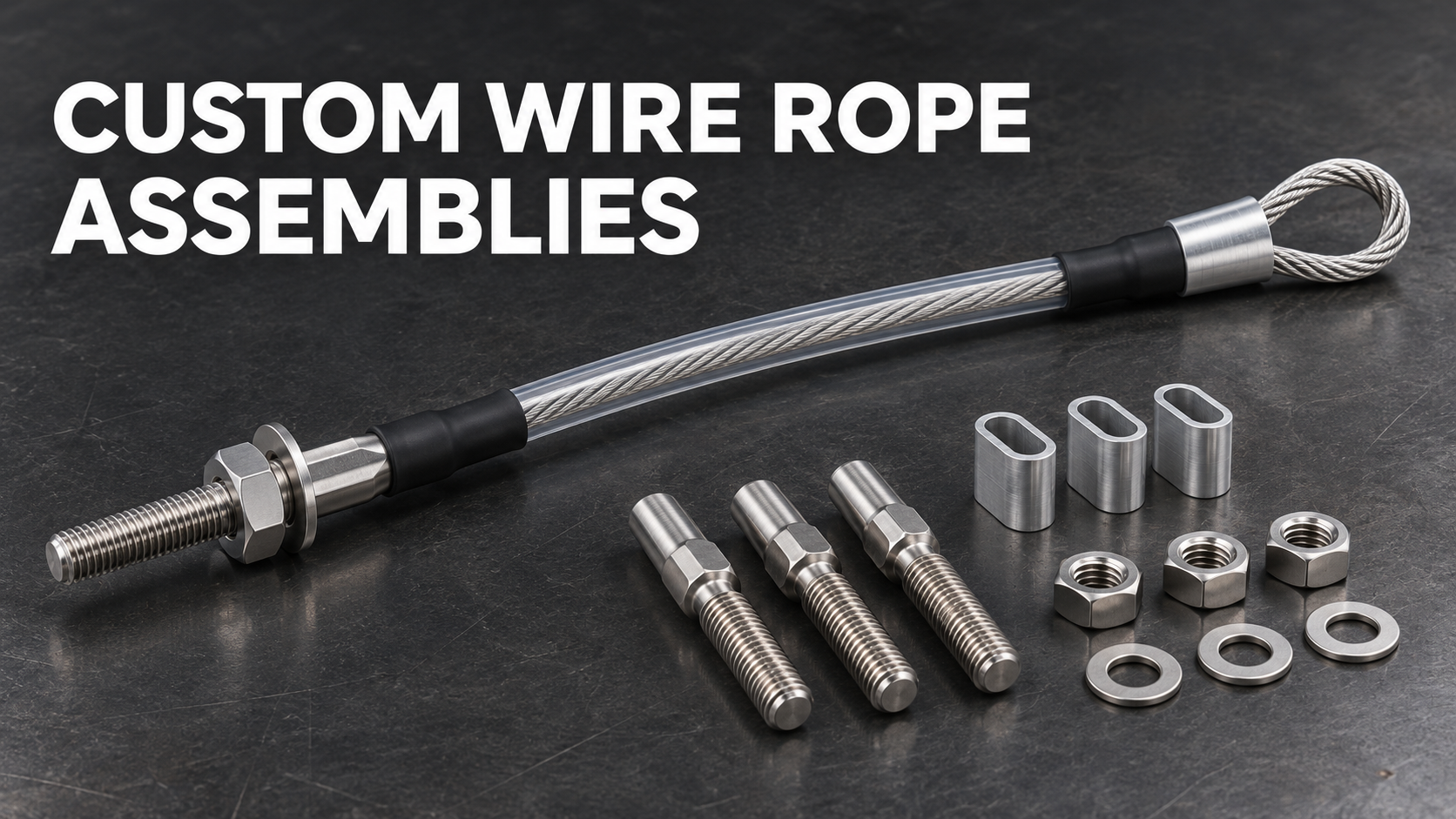
A wire rope assembly is a finished, install-ready part made from three things: a length of wire rope, a termination at each end, and — usually — some form of protective covering. Instead of receiving a reel of cable, a bag of fittings, and a crimping tool, you receive a part with a drawing number that bolts, clips, or pins straight into your product.
- The rope sets the strength, flexibility, and corrosion resistance. Most small assemblies use 7x7 or 7x19 stainless or galvanized cable from 1 to 8mm; heavier slings move up to 6x19 or 6x37 with an IWRC.
- The terminations connect the rope to whatever it holds — a threaded stud into a tapped hole, an eye over a pin, a ball into a slotted pulley or lever.
- The covering — an extruded coating, a sleeve, heat-shrink at the ends — protects hands, finishes, and the rope itself, and adds color coding.
The value of an assembly is that these parts are matched and verified together. The fitting is sized for the rope's actual diameter, the coating is stripped exactly where the fitting grips, and the finished length is checked against a tolerance. Buy the same items separately and each of those steps becomes your problem.
Anatomy of a Typical Assembly
Here is a real example from our production: a 360mm safety lanyard used to tether a removable component to a machine frame. It looks like a simple piece of coated cable, but it contains six components, and every one of them is a line on the bill of materials.
| # | Component | Specification | Qty | What it does |
|---|---|---|---|---|
| 1 | Threaded swage stud | M5 right-hand thread, 304 stainless, die-swaged onto the rope | 1 | Screws into a tapped hole or takes a nut — the fixed end |
| 2 | Heat-shrink tube | Black polyolefin, shrunk over stud shank and sheath end | 1 | Seals the sheath end and gives strain relief at the fitting |
| 3 | Wire rope + PVC sheath | 3mm 7x19, AISI 304, 1770 MPa; PVC to 4mm OD | 1 | Carries the load; the sheath protects hands and painted surfaces |
| 4 | Heat-shrink tube | As item 2, at the ferrule end | 1 | Closes the gap between sheath and ferrule |
| 5 | Ferrule (sleeve) | Aluminum oval sleeve for 3mm rope, hydraulically pressed | 1 | Locks the rope back on itself to form the eye |
| 6 | Soft eye | Bare-rope loop, specified by inside length | — | Slips over a pin, hook, or carabiner — the removable end |
A few details on this BOM are worth noticing, because they apply to almost every assembly:
- The rope sets the ceiling. A 3mm 7x19 rope in 1770 MPa grade has a minimum breaking force of about 6.27 kN (1,409 lbs) — see the full table in our wire rope breaking strength chart. The terminations decide how much of that the assembly actually delivers. 7x19 was chosen over 7x7 here because a lanyard is handled and bent constantly; our 7x7 vs 7x19 comparison explains the trade-off.
- Diameter means the steel, not the coating. "3mm coated to 4mm" is a different rope from "4mm coated". Always state both the core diameter and the finished OD, and if you are working from an old part, our guide on how to measure wire rope diameter shows how to measure the core under the coating.
- The sheath is stripped under both fittings. Swaging over plastic gives a joint that grips the coating instead of the steel and can pull out at a fraction of the rated load. The coating is cut back to bare rope where the stud and ferrule grip, and the heat-shrink covers the transition.
- Cut length is not finished length. The rope enters the stud shank and the eye consumes rope on its way back into the ferrule, so the cut length is noticeably longer than 360mm. The factory calculates it from the stud insertion depth, eye size, and ferrule length — one more reason to specify the finished dimension and let the maker own the rest.
- Aluminum ferrules suit dry, indoor use. Aluminum against stainless rope in a wet or salty environment corrodes galvanically. For outdoor or marine lanyards we switch to copper or stainless sleeves.
Common End Terminations
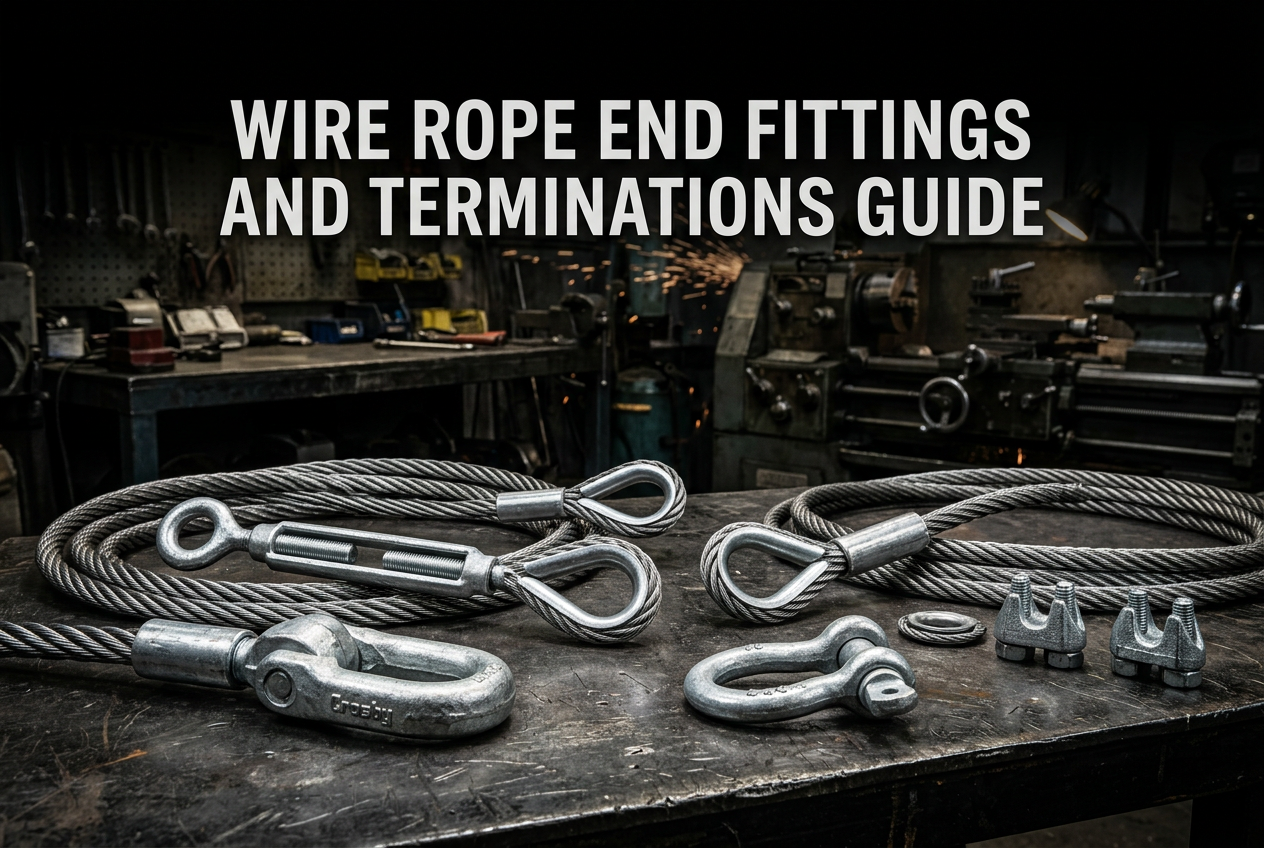
The termination is where most of the specification effort goes, and where most failures happen — industry data attribute the large majority of wire rope failures to the termination rather than the rope. These are the fittings you will meet on assembly drawings. For the hardware that sits outside an assembly — thimbles, turnbuckles, clips, shackles — see our wire rope end fittings guide.
Swage Studs (Threaded M5–M12)
A swage stud terminal is a threaded rod with a hollow shank. The rope is inserted into the shank and the shank is die-swaged around it, so the rope and stud become a single piece. Studs are the standard termination for cable railing, architectural tension rods, and any assembly that has to be tensioned or bolted to a tapped hole. Specify the thread (metric M5–M12 or UNC/UNF), thread hand — left-hand threads on one end let a stud double as a tensioner — and the threaded length. Typical pairings are:
| Rope diameter | Typical stud thread | Common use |
|---|---|---|
| 3mm | M5 | Lanyards, light tethers, display systems |
| 4mm | M6 | Light railing infill, signage, green facades |
| 5mm | M8 | Residential cable railing |
| 6mm | M8 or M10 | Commercial railing, balustrades |
| 8mm | M10 | Architectural tension systems |
| 10mm | M12 | Heavy architectural and structural rigging |
Pairings vary between fitting makers, so confirm against your mating hardware — a stud that is too small for the rope is the weak link, and one that is too large wastes money and space.
Eye & Fork Terminals
A swaged eye terminal has a flat, drilled tongue at the end of the shank; a fork (clevis) terminal has two prongs and a cross pin. Both are swaged on the same way as a stud and connect the rope to a bracket, chainplate, or lug with a bolt or clevis pin. Specify the pin diameter, the jaw width for forks, and the material — 316 for anything outdoors. Eye and fork terminals give a neater, stronger, more compact connection than a looped eye, and they are the usual choice where an assembly pins to a structure.
Ball & Shank Fittings
Ball fittings — single-shank balls at the end of the rope, double-shank balls swaged mid-cable — locate the cable in a slot or socket rather than bolting it. They are standard on control cables, lever and pulley systems, and many gym machines. Related fittings include stop sleeves (cylindrical buttons swaged onto the rope as a stop) and shank-only terminals for drilled-end connections. On a mid-cable ball, give its position from one end with a tolerance.
Soft Eyes with Ferrules & Thimbles
The most common termination of all: the rope is looped back and locked with a pressed ferrule. A soft eye (no thimble) is flexible and compact — right for lanyards and tethers that slip over a pin or carabiner. Add a thimble when the eye takes real load over a shackle or hook: it keeps the rope from bending too tightly and wearing at the bearing point. Specify the eye's inside length (or the thimble size), and the ferrule material — aluminum for galvanized and dry indoor use, copper or stainless for stainless rope in wet conditions.
Bare Cut Ends
Some assemblies are simply rope cut to length, with the ends sealed so the customer can terminate them in their own fitting. A bare end has to be finished so it does not unravel: fused or welded ends on stainless, tape, or heat-shrink caps. If you plan to cut and terminate in-house, our guide on how to cut wire rope without fraying covers the methods; otherwise, ordering factory cut-to-length pieces with fused ends saves a step on your line.
Protective Coverings
Covering is optional on an industrial sling and close to mandatory on anything people touch. There are three ways to do it, and many assemblies use more than one:
- Extruded coating (PVC, nylon, or PE). Plastic is extruded directly onto the rope at the mill, so it is bonded, round, and continuous. PVC is the general-purpose choice and comes in almost any color; nylon is harder and more abrasion resistant, which is why gym cables use it; clear coatings let an inspector see the wires underneath. Our coated wire rope is available in 7x7 and 7x19 from 2 to 8mm finished OD.
- Loose sleeving and plastisol dip. A PVC tube slid over the rope, or a plastisol dip on the eye or ferrule, protects one zone of an assembly — the eye that rubs on a frame, or the ferrule that would otherwise scratch a painted surface. Sleeving is also a way to add color or padding to rope that was not coated at the mill.
- Heat-shrink at the terminations. Wherever the coating is stripped for a fitting, a short length of heat-shrink seals the cut end so water cannot wick under the coating, stops the coating from creeping back along the rope, and gives some strain relief where the rope enters the fitting. It is also an easy way to color-code assemblies of different lengths.
When you specify a coated assembly, give the core diameter, coated OD, coating material and color, and where the coating stops. "Coated full length, stripped under fittings, heat-shrink both ends" is a complete description.
Factory Swaging vs Field Crimping
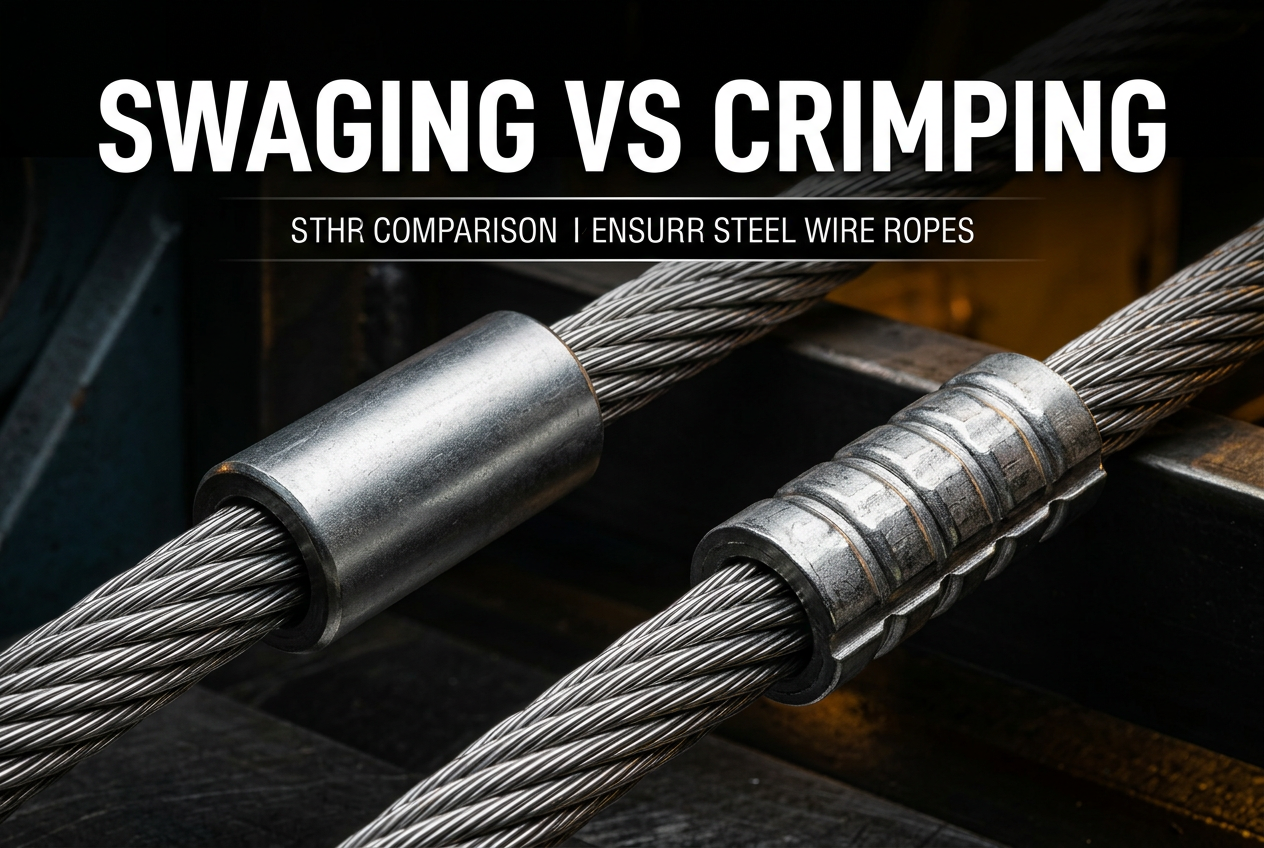
The single biggest difference between a factory assembly and one made at a workbench is how the fitting is attached. In the factory, a hydraulic or rotary swaging press closes the fitting with calibrated dies, compressing it evenly around the full circumference until the metal flows into the gaps between the strands. A handheld crimping tool squeezes the sleeve at a few points, and the result depends on the person holding it.
| Termination method | Typical strength retained | Consistency |
|---|---|---|
| Factory die-swaged stud, eye, or fork terminal | 100% of rope minimum breaking force (designed and tested to it) | Controlled by die and gauge |
| Factory hydraulic-pressed ferrule eye | 90–95% | Controlled by die and gauge |
| Hand-crimped sleeve (field assembly) | Typically 60–80% | Varies by operator, tool wear, and sleeve fit |
Three things make the factory number repeatable. The dies are matched to the fitting and rope size, so the compression is the same on the thousandth part as on the first. Every swaged fitting is checked with a go/no-go gauge on its finished diameter, which catches an under-swaged part before it ships. And first articles from each batch can be pull-tested to confirm the joint reaches the rope's rated strength — for 3mm 7x19, that is the full 6.27 kN rather than the 3.8–5.0 kN a 60–80% crimp would give.
Field crimps fall short for predictable reasons: a sleeve one size too large, too few crimps, a tool whose jaws have worn, or crimps applied in the wrong order. A carefully made crimp under ideal conditions can reach the 75–85% quoted in our swaging vs crimping guide; real field-made assemblies more often land in the 60–80% range, with a wide spread from one piece to the next. That spread is what matters for a safety part — the weakest assembly in a batch sets the real rating.
Typical Applications
| Application | Typical rope | Typical terminations |
|---|---|---|
| Safety lanyards & pin tethers | 1.5–3mm 7x7 or 7x19, PVC coated | Soft eyes, swage studs, loop and ring ends |
| Equipment tethers & safety cables (lighting, speakers, covers) | 2–4mm 7x19, coated or bare | Soft or thimble eyes with ferrules, snap hook or quick link |
| Gym & fitness cables | 4–6mm 7x19, nylon coated | Threaded studs, ball ends, stop sleeves, eye terminals |
| Cable railing kits | 3–6mm 1x19 316 stainless | Swage studs, fork or eye terminals, one end left for field fitting |
| Control & actuator cables | 1–3mm 7x7 or 7x19 | Ball and shank fittings, stop sleeves, threaded ends |
| Lifting slings | 6–20mm 6x19 or 6x37 IWRC | Thimble eyes with pressed ferrules, proof-loaded and tagged |
Gym equipment is one of the largest users of custom assemblies — every weight-stack and cable-crossover machine runs on them. Our article on wire rope for gym and fitness equipment covers the rope and coating choices, and the gym cable replacement guide explains how to copy an existing cable. For railing, see stainless steel cable railing wire rope. For lifting slings, the rated working load and the proof test are as important as the termination; the working load limit guide covers the design factors.
How to Specify an Assembly in Your RFQ
An assembly quote is only as accurate as its description. The template below covers every item a factory needs to price the part without a round of follow-up questions — copy it, fill in your values, and delete any lines that do not apply:
Part name / P/N:   Safety lanyard, P/N LY-360 rev B
Rope:              3mm 7x19, AISI 304, 1770 MPa
Coating:           PVC, black, 4mm OD, stripped under fittings
Overall length:    360mm ±2mm, stud end to eye bearing point
End A:             M5 RH threaded swage stud, 304, 20mm thread length
End B:             Soft eye, 25mm inside length, aluminum ferrule
Finishing:         Black heat-shrink at both ends
Accessories:       1x M5 nut + washer per piece
Quantity:          2,000 pcs (annual forecast: 10,000)
Testing/docs:      Rope mill certificate; first-article pull test report
Packaging:         50 pcs per bag, labeled with P/N and quantity
Delivery:          FOB Shanghai, required date
Drawing:           Attached (PDF / DWG)
The lines that most often cause re-quotes are:
- Length without a reference point. "360mm" can mean stud end to eye end, stud end to the inside of the eye, or the visible coated length. State both reference points and a tolerance.
- Diameter without coating. Give the steel core diameter and the coated OD separately.
- Termination without size. "Threaded end" needs a thread size, hand, and length; "eye" needs an inside length or thimble size.
- Quantity without a forecast. A one-off quantity and a repeating annual volume are priced differently; giving both gets you the better price.
A drawing beats any description. Even a hand sketch with dimensions removes most ambiguity, and a dimensioned drawing lets us check the design — stud size against rope size, ferrule material against environment — before quoting. If you have no drawing, send a sample or a photo of the part next to a ruler, and we will return a drawing for your approval before production.
Why Order Assemblies Factory-Direct
Making assemblies in-house looks cheap because the rope and fittings are inexpensive. The real cost is everywhere else. Ordering finished assemblies directly from a rope manufacturer removes it:
- Lower total cost. You buy one part at one price instead of rope, fittings, sleeves, and heat-shrink from different suppliers — with no distributor margin on the rope, no scrap from offcuts and failed crimps, and no labor on your line.
- No equipment investment. A hydraulic swaging press, a set of dies for each rope size, gauges, and a cutting and test setup run to thousands of dollars before the first good part. A factory already has them and spreads the cost over its whole output.
- Consistency. Calibrated dies and gauged fittings mean the thousandth assembly matches the first, and the rope for a batch comes from a single production lot.
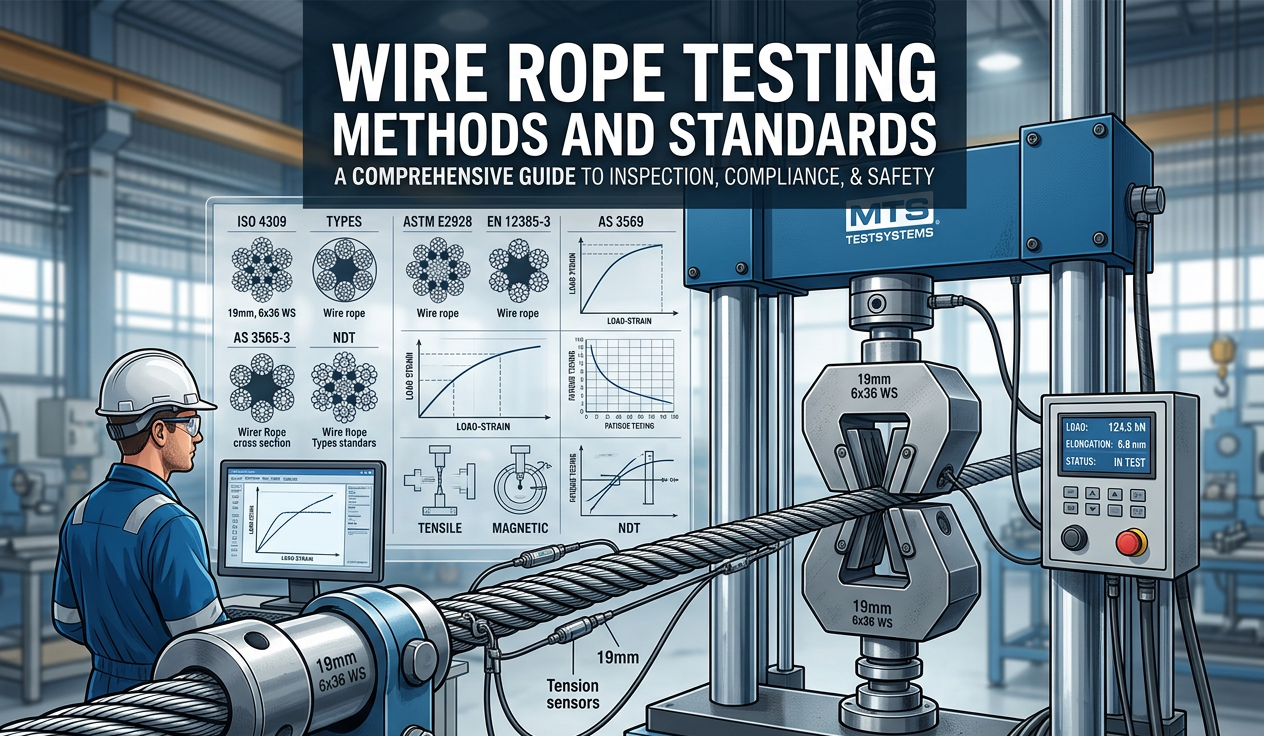
- Test reports and traceability. Each batch can ship with the rope's mill certificate and pull or proof test results for the finished assemblies — documentation that is hard to produce from a workbench. Our guide to wire rope testing methods and standards explains what those reports contain.
- Ready to install. Assemblies arrive counted, bagged, and labeled by part number — straight onto the production line or into the kit box.
Because we manufacture the rope ourselves, the rope, fittings, coating, and testing for an assembly sit under one roof, so the assembly is priced from the rope up rather than marked up at each step. See our full rope range on the products page and the constructions and diameters on the specifications page.
Frequently Asked Questions
What is a wire rope assembly?
A wire rope assembly is a length of wire rope that has been cut to a specified length and fitted with end terminations — such as swaged threaded studs, eye or fork terminals, ball fittings, or ferrule-secured eyes — and often a protective coating or sleeve. It arrives as a finished part, ready to install, rather than as loose rope and fittings.
Is factory swaging stronger than hand crimping?
Yes. Factory hydraulic or rotary swaging compresses the fitting evenly with calibrated dies, and swaged stud and eye terminals are designed to develop the full rated breaking strength of the rope; pressed ferrule eyes typically retain 90–95%. Hand crimping deforms the sleeve at a few points and depends on the operator, so field-made crimps typically reach only 60–80% of rope strength, with wide variation from piece to piece.
What is the minimum order quantity for custom cable assemblies?
For assemblies built from stock rope and standard fittings there is usually no fixed minimum: samples and prototype runs of a few pieces can be made to approve the design. Unit price falls substantially from a few hundred pieces upward, because setup — die changes, cutting setup, and first-article testing — is spread across more parts. Custom-made fittings or special coating colors may carry a higher minimum.
How is the length of a wire rope assembly measured?
Overall length is normally measured from the end of one fitting to the bearing point of the other — for example, from the tip of a threaded stud to the inside of an eye, where a pin or shackle would bear. Because conventions differ, the drawing or RFQ should state both reference points and the tolerance, such as 360mm ±2mm, stud end to eye bearing point.
Can you make an assembly from a sample instead of a drawing?
Yes. A physical sample is often the fastest route when no drawing exists: we measure the rope diameter, construction, coating, length, and fittings, then send back a dimensioned drawing for approval before production. A clear photo next to a ruler, with the rope diameter and overall length noted, is usually enough for a first quote.
Get a Quote on Your Assembly
Send us your drawing, a sample, or the filled-in RFQ template above — rope, length, both terminations, coating, and quantity — and our engineering team will check the design, confirm the termination ratings, and return a factory-direct quote, typically within 24 hours.